To watch the video recipe of Nasarpuri style Seyal Bhaji, please check my Youtube channel, SindhiRasoiOfficial. Click here to visit the link!
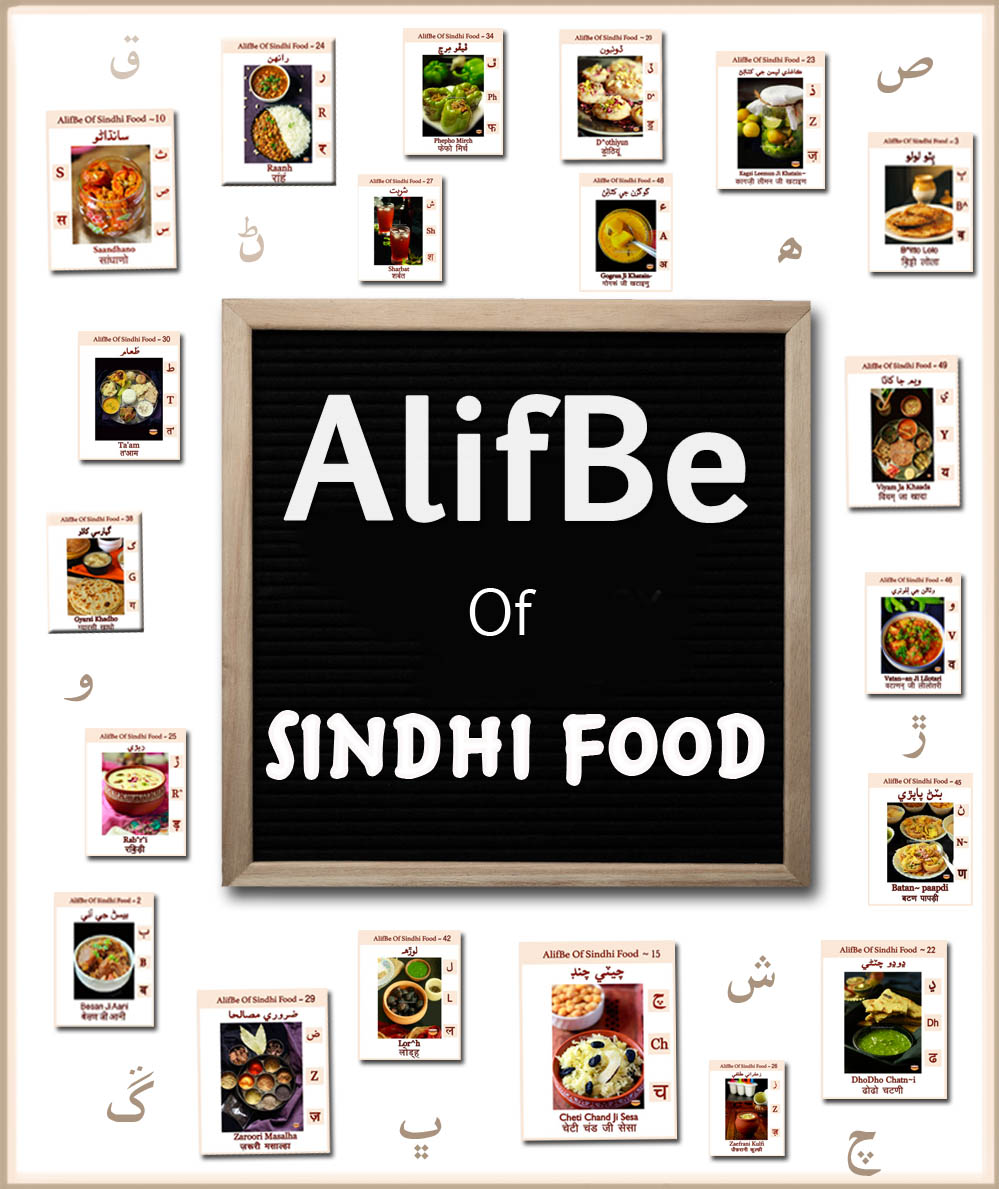
The 44th ‘alphabet’ of Arabic Sindhi Script, AlifBe, is ن in Sindhi, न in Devanagari and ‘N’ in Roman Sindhi. N as in Nagpur, Nagaland, Nigeria or as in Nasarpur.
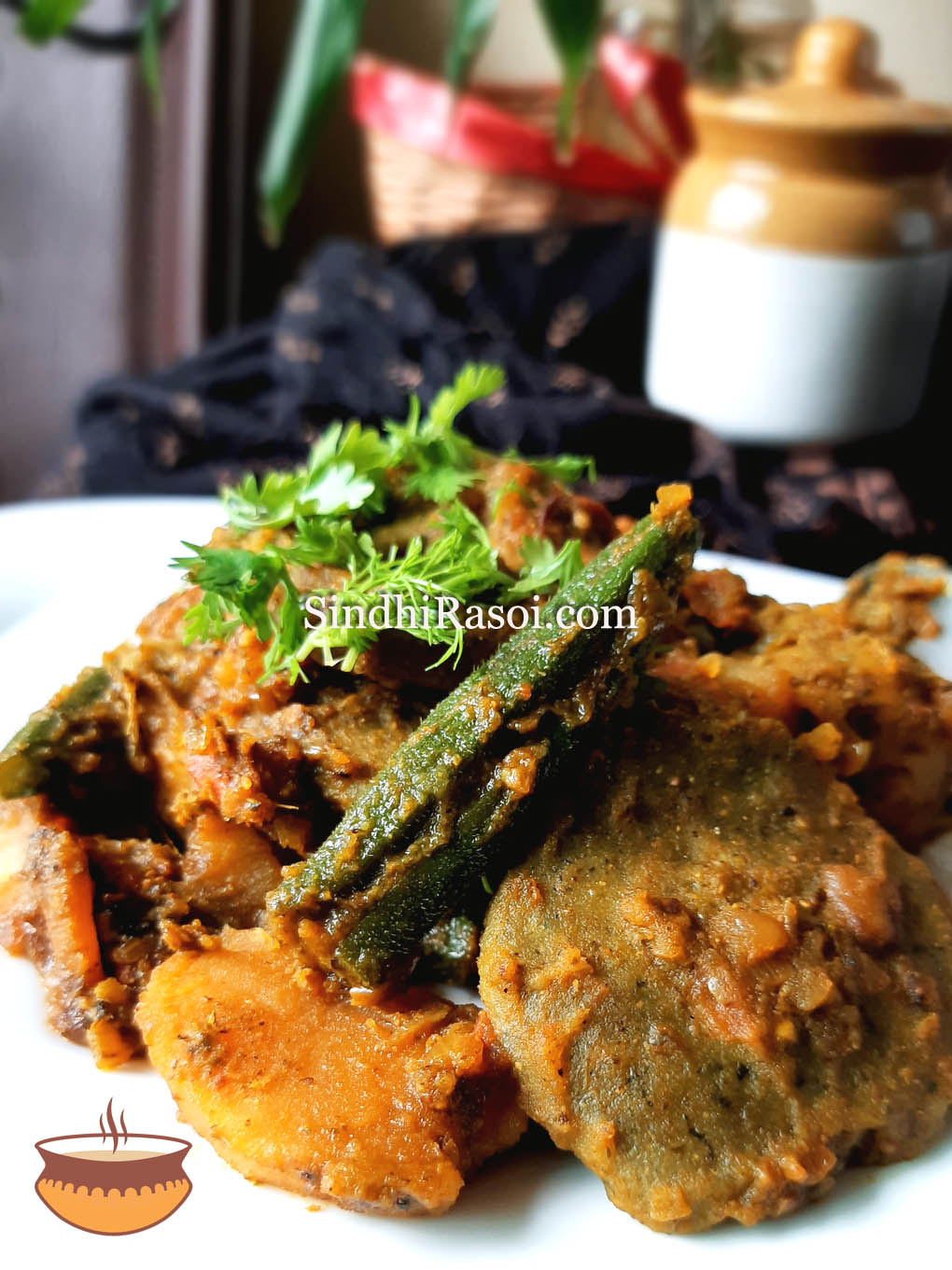
And the corresponding dish is ‘ Nasarpuri Seyal Bhaji, with Dhokri (Dhokryun)’.

Nasarpur (Nasarpur/Nasserpur):
Nasarpur is one of the oldest known places in Sindh (now in Pakistan), that finds mentions in not only the history and geography of ancient civilization, but also in the legends associated with the Lord Jhulelal, an incarnation of Varun Dev, that the Sindhis have great faith in!
It is in the small town of Nassarpur that the Lord Jhulelal was born and hence the place holds a great significance for the Sindhi community.
Nasarpuri Sindhis are those whose ancestors came from Nasarpur and this Sindhi subset is a small community consisting of barely few hundred families, residing in India and abroad.
Honestly speaking I was not aware of the culture, traditions and cuisine of Nasapuri Sindhis till I came across some people in Sindhirasoi fb group.
And then I got in touch with Jyoti Mulchandani, a fabulous lady working on many aspects of Sindhi culture, language and people, who enlightened me more about the Nasarpuri culture. You can check her blog, SindhiKhazana to gain more insights.
She also introduced me to her sister Geeta (Urvashi Dhama) and I got to learn so much from her, not only about the Nasarpuri community, but also about the Brahmakhatris, yet another Sindhi subset with lesser exposure in the so called mainstream Sindhi community.
Thanks to the two sisters I came to know how popular the Seyal Bhaji (in green gravy base) is, in the Nasarpuri cuisine.
I also came across some information about Dhokri (Dhokni) i.e the flat dough discs, steamed/ cooked in the seyal style base, consumed by some Sindhis. I was intrigued.
I am utterly grateful to Pooja Abichandani who not only guided me about Nasarpuri food but also helped me connect with Ms Rashmi Chandani who shared helpful details about the community along with detailed recipes of some of the popular dishes from Nasarpuri cuisine. I am so eager to share all of her recipes, one at a time, on this blog of mine!
Pooja Abichandani also introduced me to her mother Ms Rekha Khushalani and oh my! we kept on talking about Sindhi food, food and more food, for hours, till my voice started cracking. Got to learn so much from her about Nasarpuri food and it was such a pleasure to share food memories with each other.
Of all the recipes she discussed with me, the Seyal Bhaji was one of the prominent. While she mentioned that Dhokri are added in Nasarpuri style Seyal Bhaji, Rashmi Chandani, on the other hand, believes that Dhokri is not a Nasarpuri addition.
I was too intrigued with the idea of addition of Jowar/bajra dough discs in the seyal masala to give it a miss. But since the Dhokri part of the Seyal bhaji is not confirmed to be Nasarpuri style, I chose to name the dish just ‘Nasarpuri Seyal Bhaji’, a traditional dish loved by Nasarpuri as well as other Sindhis belonging to different subsets.
The Nasarpuri Seyal Bhaji is basically a semidry curry made using a base of green paste made from coriander leaves, chillies, ginger and garlic. Some add onions in the paste, some add tomatoes as well. Some use chopped or grated onions and tomatoes. One can add any combination of vegetables to this green base, but the most preferred ones are potatoes, Okra, Apple gourds (Meha/Tinde) and small onions. Potatoes are always cut into thick roundels while other veggies are used whole. Some like to stuff vegetables with green masala while others just cook it without stuffing.

You can make the Dhokri (also called Dhokni) from Jowar, Bajra or rice flour to which one needs to add the green masala paste, some salt and oil for moyan to make a dough. You can totally skip the Dhokri part and make the subzi with just the vegetables of your choice.
Traditionally when such a subzi was made, the Dhokris were laid on a piece of the mulmul cloth that was tied over the rim of the vessel in which the Seyal bhaji was being cooked. The steam arising from the Seyal bhaji would cook the Dhokris and then these were added to the Seyal bhaji and cooked further to absorb more flavors of the Seyal bhaji.
Many skip this tricky step and simply place the dough discs, the Dhokri as the top most layer on the Seyal bhaji, and cook it covered, on the low flame, without mixing it, till the Dhokris are steamed (i.e cooked) well.
I found a middle path!
I have the Idli steamer plate that fits well over the Kadai that I used for making Seyal Bhaji (Refer the Video) and I used it to steam the Dhokri.

The recipe that I followed was a mix of many recipes that I picked from the SindhiRasoi group. Thank you Tanisha Makhija, Nana Kunwar, Pooja Abichandani, Rashmi Chandani and Rekha Khushalani ji for all your valuable inputs.
- A bunch of coriander leaves
- 4-5 green chillies
- 1 inch piece ginger
- 10-12 garlic cloves
- 2 Onions
- 2 Tomatoes
- 2 Potatoes
- 7-8 Okra
- 2-3 Small tender Apple Gourds (Meha/TInde) optional
- 2 Small whole onions optional (I didn't use onions)
- 1 tsp Turmeric Powder
- 2 tsp Coriander Powder
- 1 Cup Jowar/ Bajra flour
- 3-4 tbsp Oil
- Salt as per taste
- Blend or pound using mortar and pestle, coriander leaves, chillies, ginger and garlic. Make a coarse paste.
- Save 2 -3 tbsp of this paste to make Dhokri.
- To make Dhokri, mix the above reserved paste with 1 cup of Jowar/Bajra/rice flour and add some salt and 1 tbsp of oil. Mix everything well and using water, a little at a time, bring together the mixture to make a firm dough. No need to knead the dough. Divide it in 7-8 portions and make small flat discs of each portion. These are called Dhokri (Dhokni). Grease each with some oil and keep covered till further use. Ideally one should make Dhokri just before steaming it but to avoid confusion I have mentioned the process in the beginning. Watch the video to understand the steps properly.
- Heat 2-3 tbsp of oil in a pan.
- Add 2 small onions, finely chopped.
- Cook on medium heat till translucent (slightly pink)
- Add the green paste
- Add a little of salt and cook till rawness of green paste disappears i.e for 4-5 minutes.
- This is an optional step but it gives more flavor to the whole vegetables. Remove 2 tbsp of this cooked mixture and use it later to stuff Tinde and Okra. You can use whole vegetables without stuffing too.
- Add chopped tomatoes, some salt (salt is to be added in various stages so add a little at a time), turmeric and coriander powder and cook on medium heat while the pan is covered with a lid.
- Meanwhile peel and slice potatoes in thick roundels and soak these in salted water till further use. Peel and slit apple gourds, onions, if using, into criss cross to make a space for stuffing. Tip off the ends of Okra and slit each from top (head) towards the tip.
- Coming back to the gravy, mash tomatoes and then add potato roundels. Stir to coat potatoes and cook covered on medium heat for 2-3 minutes.
- Stuff Apple gourds, onions and Okra with the cooked onions and green masala mix that we saved.
- Since potatoes take longer to cook, we added it first. Now add stuffed gourds and onions (if using) and gently mix the sabzi.
- Add 2 cups of water to the sabzi and place an idli steamer plate over it. Traditionally a muslin cloth was tied over the rim of the vessel but I found it to be tricky hence used the idli plate. Luckily my idli plate fits well over the kadai that I used for making the sabzi.
- Lower the heat to minimum. Place a clean piece of mulmul cloth over the plate. Moisten it slightly.
- Place the Dhokryun on the cloth adjacent to each other.
- Cover the lid of the pan and allow everything to cook on low heat.
- The stuffed vegetables will cook inside the pan and the Dhokri will get steamed above the pan using the steam arising from the boiling gravy.
- After 7-8 minutes, the Dhokri will be set. Transfer each on a plate carefully.
- Give the sabzi a mix, add few tbsp of water (or more if you need a little gravy) and make a layer of stuffed bhindi (okra) and steamed Dhokri above the sabzi.
- Cover and cook on low heat for 5 minutes.
- Flip once, very gently and cook covered, for 5 more minutes.
- The Nasarpuri style Seyal Bhaji with Jowar Dhokri is ready to relish.
- Ideally had with roti, but you can enjoy it as a side dish with dal rice or have it just as it is since the Jowar Dhokri is very filling and tastes amazing in combination with potatoes, okra and gourds.
- Here is a simpler version of the recipe:
- Blend 2 small onions, 2 tomatoes, coriander leaves, ginger, garlic and chillies to make a paste
- Use some of this paste to make Dhokri and add the rest of this paste in a pan with 3 tbsp of oil.
- Cook on medium heat till rawness of onions and garlic is gone.Add salt, turmeric and coriander powder.
- Add potato roundels and a little salt. Cook and cover for few minutes. Add 2 cups of water.
- Lay other whole vegetables (apple gourds, onions, Okra) and Dhokris above the potato and gravy mix. Do not mix.
- Cover and allow to cook on low flame for 10 minutes or so. Stir very gently so as to not break the Dhokri.
- Cook covered for 8-10 minutes more, till a knife pierced in Dhokri comes out clean.
- Make Dho
And finally, a small video tutorial to learn how to write in Arabic Sindhi: