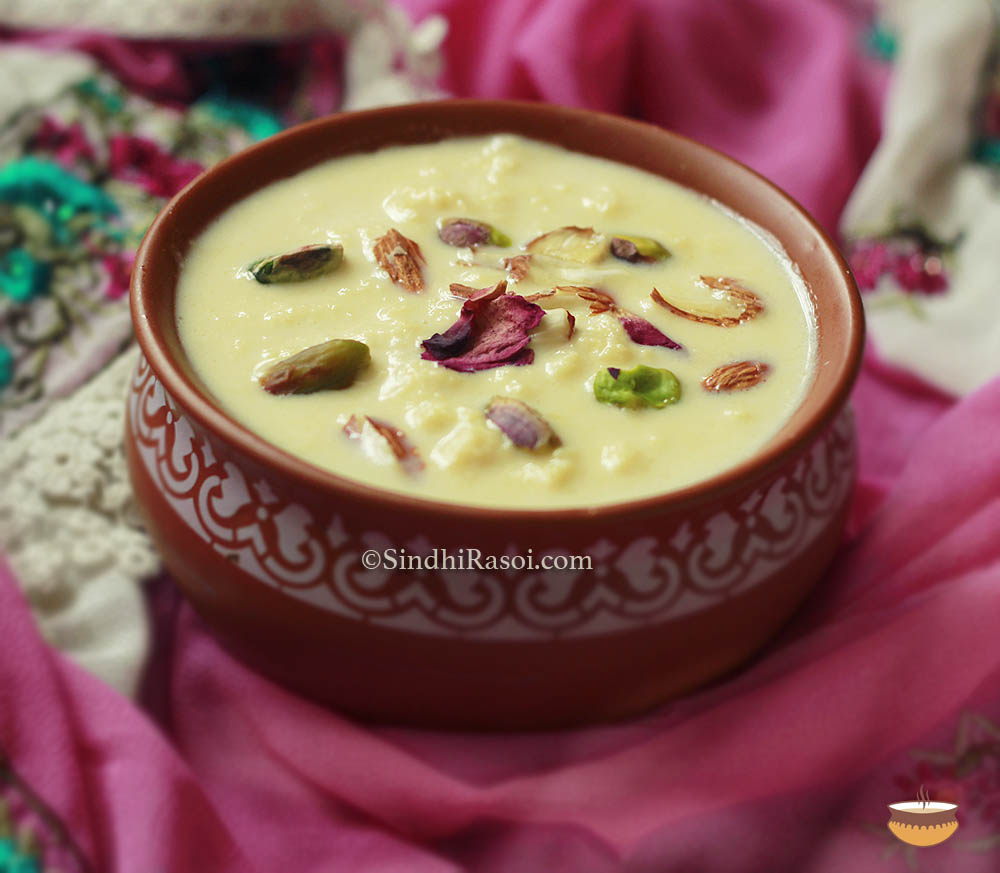
The Dairy products could be divided in many types, for example, heat desiccated (khoya), heat and acid coagulated (paneer, cheese), clarified butter (ghee), frozen (Ice cream), frozen concentrated milk (Kulfi variant) and condensed or concentrated products like Rabdi, Basundi etc.
In the spotlight today is the Rabri or Rabdi or as many Sindhis call it, Reb^di!

Rabri is a concentrated, sweetened whole fat milk and is considered to be of high nutritive value.
It is a traditional preparation and its variations are mentioned in ancient food manuscripts, in food related accounts from 16th century and even in popular Mangal Kavyas (Poems of Benediction, in Bengali literature) composed between 13th (or is it 15th?) to 18th Century!
There are plenty of versions of Rabri depending on the flavors of the ingredients used, for example, the dry fruit rabri, Khoye waali Rabri, Sitaphal (Custard Apple) rabri or Seb (Apple) rabri, Kesar, Mango, Gulkand Rabri etc. Also, depending on the process of making Rabri and on the texture of the final product, a Rabri it could be classified as Ghatta Rabri, Lachedar, Lachedar khurchan waali, Sar Rabri, Basundi, Faluda waali rabri , Chena Rabdi etc.
The basic rules of making a Rabri are same i.e Simmer full fat milk till three fold or four fold concentrations (i.e till it reduces to 1/3rd or 1/4th of its original volume), add sugar and cook a little more. But different kinds of rabri are made by adopting different methods of treating the cream (malai) collected while the milk is being reduced.
As the milk is gently simmered, layers of cream appear on the surface. The milk is allowed to simmer undisturbed as stirring would hamper formation of cream layer. Milk is stirred gently only at intervals to prevent the milk from sticking to the bottom of the Kadai.
The simmering milk is fanned from the top so that the surface is cooler so as to facilitate formation of cream layers from time to time. The thin cream layers are carefully collected either on the side of the pan/kadai or allowed to thicken a bit and then collected in another vessel only to be added back at the later stage!
While on the side of the pan, the cream layers tend to dry out and are then scrapped and added to the final sweetened concentrated milk (here, the rabri) and hence the term Khurchan (the scrapes)!
If the cream layers are thinner and are scraped from the sides and mixed in, the rabri is called Khurchan waali Rabri .
If the slightly thickened cream layers are mixed and stirred in the rabri the resulting chunkier rabri is called Ghatta Rabri. The texture is not very different in both the cases and many would call both as the Rabri.

If larger chunks of thick cream layers are dunked in the rabri it is called as Lachedar (flaky) Rabri. But again, not many consider Lachedar and Khurchan types to be different.
Many even label either of it as Lachedar Khurchan waali rabri.
Then there is Bengali style Sar Rabri where the malai is really thick and it is neatly cut into slices (squares or rectangles) and served with some thickened milk.
Basundi on the other hand is more smooth (creamier) and little runny as compared to the Lachedar Rabri and is generally without any clotted cream (flakes).
Rabdi for Faluda is less chunkier than Lachedar but more concentrated and grainier than Basundi!
Mostly commercial Rabri is made from high fat Buffalo milk (6% or above, fat) and while some rely on basic ingredients i.e Milk and sugar only, you may find a Rabdi that is made using a little of Tatri (citric acid crystals), lemon juice, curds etc.

A perfectly made Rabri will have chunkier malai bits and smooth condensed (concentrated) milk and not the chunks suspended in milk that looks curdled or whey like.
And well, by now you may have figured out why the Rabri is in spotlight today, no?
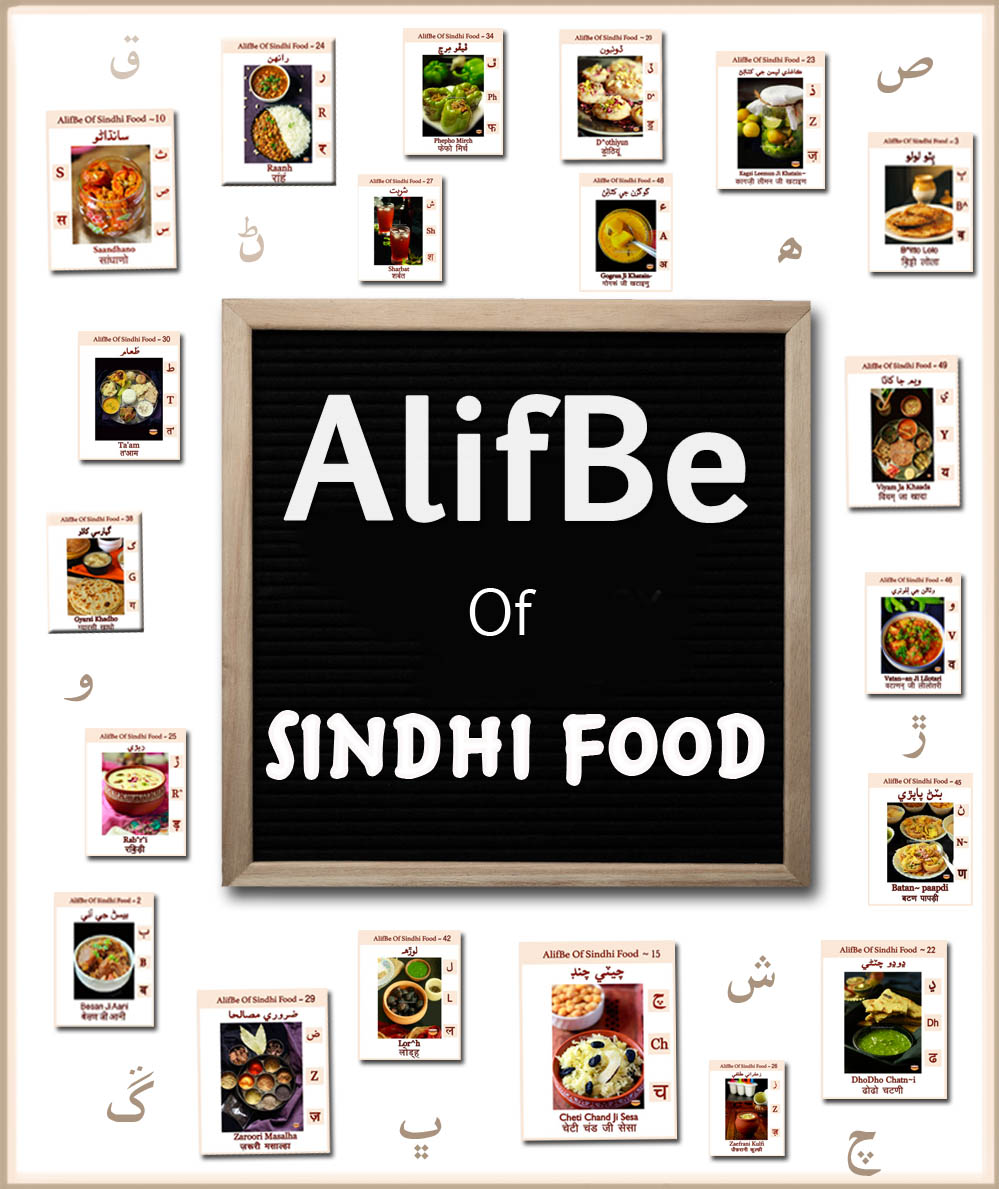
The 25th letter in the AlifBe of Sindhi food is ڙ in Sindhi, ड़ in Devanagari and is represented by R^ in Roman Sindhi. No word starts with ड़ in Devanagari and so is the case with Arabic Sindhi too and hence ڙ never comes in the beginning of any Sindhi word. The consonant sound (Voiced retroflex flap ) is peculiar and is used in few languages only.

Sindhi and Devanagari Transliteration courtesy Deepak Keswani and Barkha Khushalani!
Some Hindi words where this letter is used are:
लड़का, पेड़, लड़ाई and of course रबड़ी
Kindly note that the Rabri words begin with another R (We have covered it in the Previous post)!
Rating
- 1 lit full fat milk ( I used Amul's milk with 6% fat)
- 3 Tbsp Sugar (Add a tbsp more if you like it very well sweetened)
- Take a thick bottomed kadai, add 2 tbsp of water or grease the kadai with ghee.
- Pour full fat milk and heat it on medium to high flame till it starts bubbling.
- Lower the flame. Remaining process needs to be done on medium flame only. A very low flame will not only increase the making time but will also alter the color of the final dish .
- Traditionally one has to swing hand held fan over the kadai to ensure that the cream is formed quickly. I just kept switching the ceiling fan on and off but it was not of much help!
- Do not stir milk very frequently as it will hamper cream formation. Just keep a spatula in the kadai and at decent intervals gently scrap the bottom of the kadai with it, without lifting the spatula off the surface.
- Collect the cream formed on the surface and gently move it to the sides of the kadai. Allow the cream to dry while being stuck on the sides. Keep collecting cream by pushing it to the sides and keep sticking cream on the sides of the kadai.
- Continue with the process till the milk is reduced to ⅓rd of its original volume. You can go ahead till it is ¼th of its volume.
- Add 3-4 tbsp of Sugar and gently mix it.
- Now mix in the thickened flakes and scraped dried thin layers in the reduced, sweetened milk.
- Allow the mix to cook a little more and then transfer the contents in a bowl.
- Once cool enough, refrigerate the Rabri for few hours.
- Rabri tends to thicken after cooling and more so, after the refrigeration.
- If you find it too thick for your liking after it is cool, simply mix in few tsp of boiled (but warm) milk.
- You can add saffron, cardamon, dried nuts etc if you wish to make Kulfi from this Rabri.
And for those who are following the AlifBe series to learn Sindhi script, here is a short video about how to write ڙ in Sindhi:

very nice recipe can you share more recipe like this on your blog.