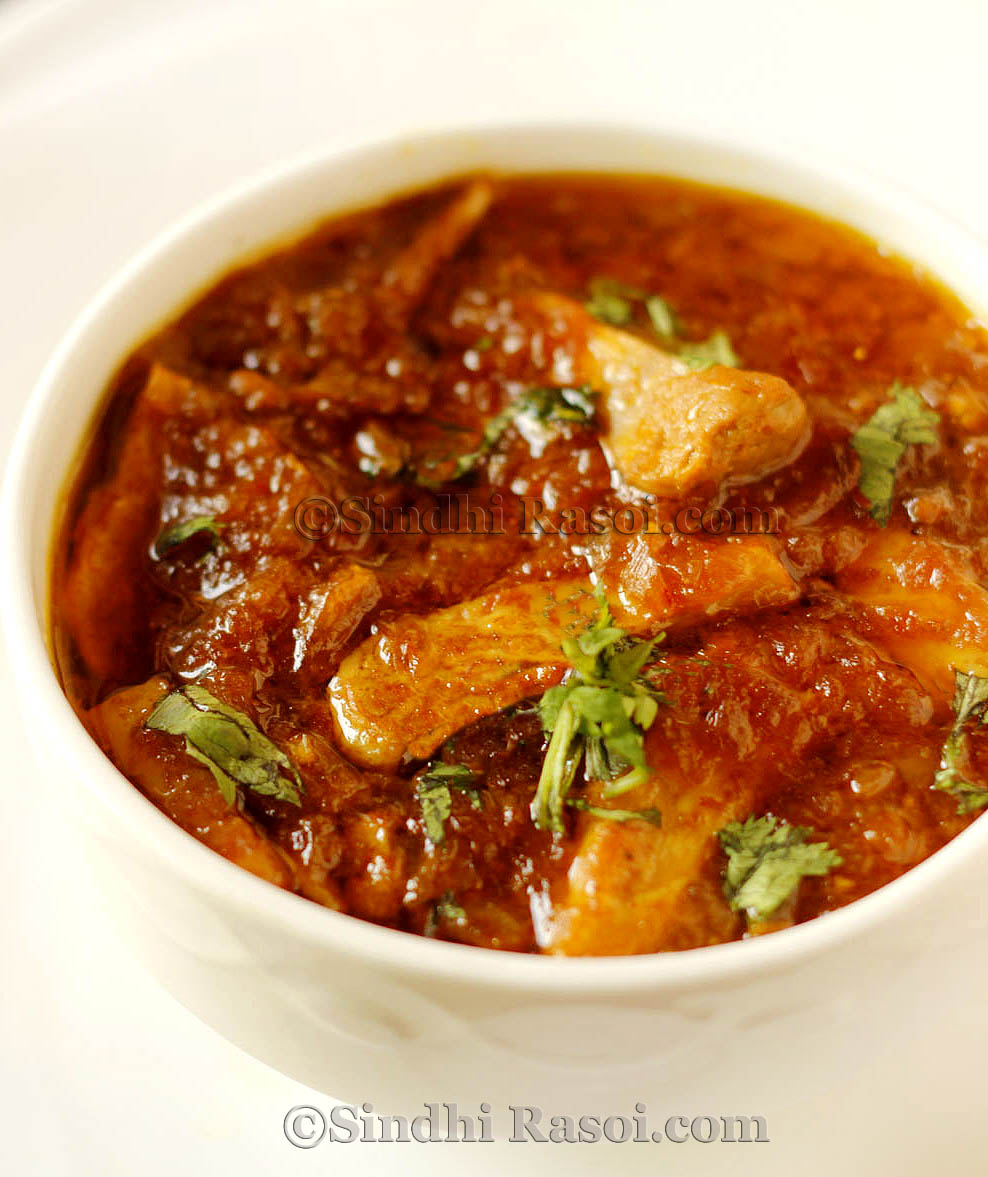
My hubby’s grandmother often used to talk about some lost Sindhi recipes and the way vegetables and other ingredients lack the original flavors. She would rant about the ‘not so fragrant’ fenugreek leaves, insipid spinach and flavorless ghee and would compare it with the quality of ingredients that were available in the past. She would frown at the sight of lack luster parathas and would ask for a dollop of ghee or white butter to bring parathas to life. Her ‘old food’ stories would often be about the succulent meat curries, exotic ‘sand-pit-cooked’ fishes, Doli ji roti (a fried poori made from fermented spiced up broth and stuffed with Bengal gram) and dhingri (dried mushrooms/morrels) curries.
When the readers of my blog would ask me about some lesser known recipes from Sindhi cuisine she would pitch in and with a twinkle in her eyes and nostalgic memories in her heart she would describe the way these exotic dishes were cooked, back in Sindh, in undivided India. She would tell how the dhingri or morrels were considered as a delicacy back then (they still are precious and rare to find) and how in the absence of fresh ones, dried regular mushrooms could be used to make Sindhi style mushroom curry. Her mushroom curry would have oil/ghee floating and it would have strong meaty flavors.
She would also talk about Khumbyun and I never knew that those were actually different from the button mushrooms available around, until recently when Hitesh Rajai enlightened me about it. Khumbyun or Podaxis Pistillaris is a mushroom variety available for a really short time during season, in some selected parts of India. I am yet to conclude whether Khumb/ khumbi refers to any type of mushrooms or it is the Podaxis Pistillaris. Anyways I was really curious to recreate the flavors of exotic mushroom curry using the Khumbhyun irrelevant of what it is actually known as . And generous as he is (Remember the guy who sent me Mango ginger and Bhavnagri mirchis?) Hitesh immediately couriered me a parcel with more than a Kilo of these divine khumbyun. The wait was stressful but thankfully the mushrooms survived the heat, humidity, and manhandling in its long aerial and road journey from Bhavnagar to Mumbai.

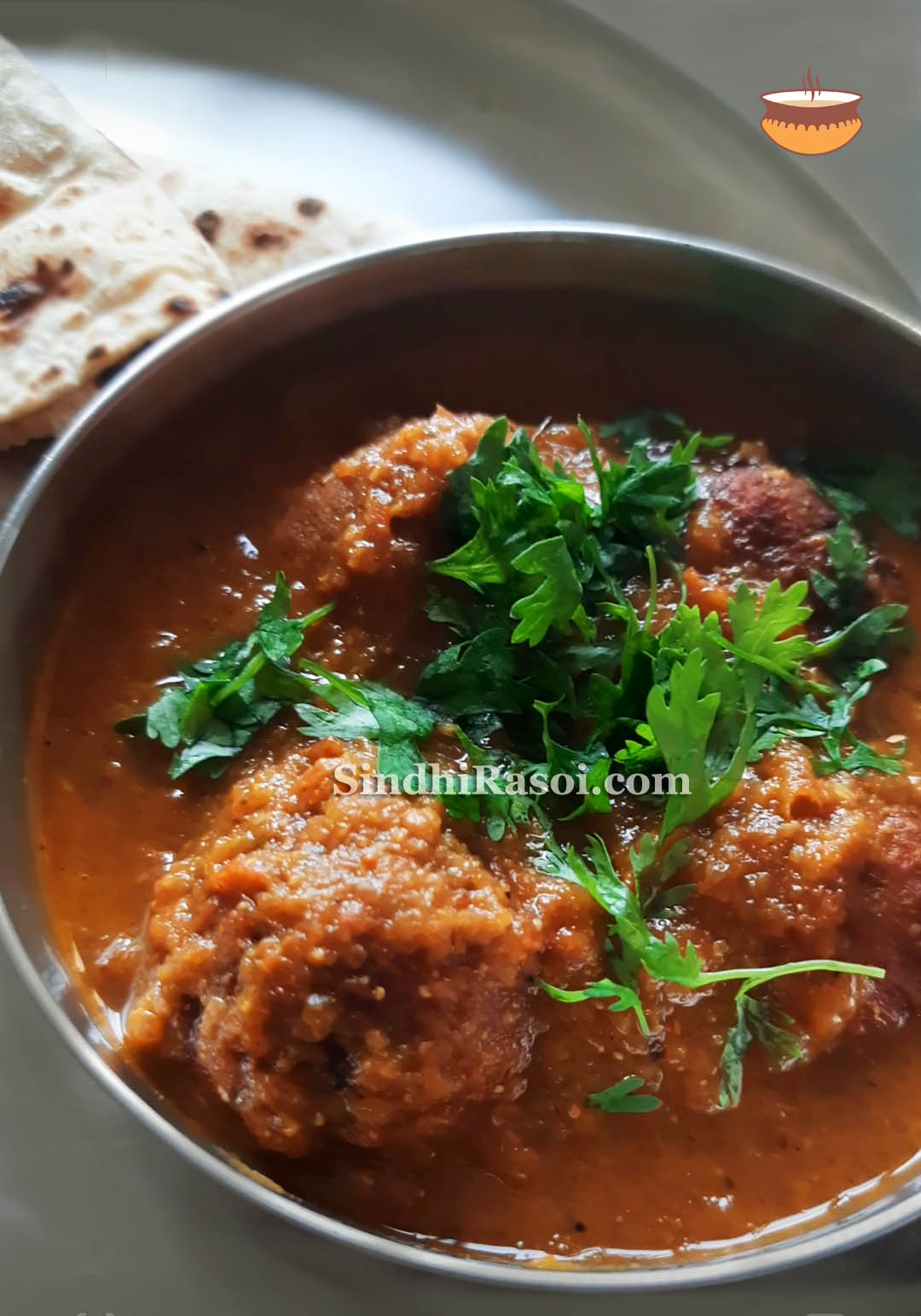
When he described the taste of the khumbyun ji bhaji that his sister makes, I couldn’t resist the urge to call her up. His elder sis, Bharti di, was more than happy to share her recipe which I followed to a T. Trust me when I say, it was one hell of flavor- packed curry, the taste of which will haunt you for a long long time..or at least till you get lucky to lay your hands on these exotic mushrooms again.
Thank you Hitesh, for taking all the troubles to make sure that the Khumbyun land at my home without any damage and thank you Bharti Didi for sharing your recipe and loads of tips to store and cook these mushrooms in various ways.
You can cook this dish using any kind of fresh or dried mushrooms. The term Daag^ mein refers to the gravy cooked with browned onions and tomatoes and it is a very basic kind of Sindhi gravy.
Kindly note that these mushrooms are different from the button mushrooms available in the markets. Unlike button mushrooms, these wont oxidize (turn black) when rinsed with water or left in open after cutting. You have to scrap Khumbyun to get rid of outer brownish skin and rinse well with water to get rid of mud or grit. Pat dry with kitchen towel and slice as you wish. To store, just pack the sliced mushrooms in an airtight container and place it inside the freezer.

Rating
Prep time:
Cook time:
Total time:

- Mushrooms 12-14
- Onions 3 large
- Tomato 1
- Green chilies 2-3
- Ginger 1”
- Tej patta 1
- Turmeric powder ½ tsp
- Coriander powder 1 tsp
- Garam masala powder 1 tsp or less
- Salt as per taste
- Oil 2 tbsp
- Coriander leaves for garnish
- Rinse well with water and scrap the skin of Khumbyun. (If using button mushrooms, clean with kitchen cloth to get rid of dirt and grit.)
- Cut mushrooms horizontally into 2 or 4 pieces or slice as desired.
- Finely chop onions, tomato, ginger and chilies.
- In a pressure cooker, heat 2 tbsp of oil (or more if you want smooth gravy) and add chopped onions.
- Sauté on medium flame till onions are brown (caramelized). Add chopped tomato, chilies, ginger and cook on high heat for a minute or so.
- Add a cup of hot water and close the lid of cooker. After the first whistle, lower the flame and let the contents cook under pressure for 5-7 minutes.
- Put off the flame and let the cooker cool down. Once the pressure is released, whisk the gravy using wooden whisk (Mandhiyaro), till homogenous.
- Add mushrooms, salt, tejpatta followed by turmeric, coriander powder and garam masala powder and mix well. Add 2 cups of hot water and again close the lid of cooker. Cook for 3-4 whistles or lower the flame after first whistle, and cook under pressure for 10 minutes.
- Garnish with coriander leaves and serve Khumbyun ji Bhaji with roti or as a side with Dal and rice.


What a wonderful read. Thank you for this blog. I learnt about a new ingredient and absolutely loved the way you’ve penned it.
This coming from you means a lot to me! Thank you for your kind words!
I made this recipe at home. It tastes great. I normally don’t like mushrooms. But this one was awesome.
I m from tharparker sindh n so excited to see it recipe as we get khumbi every sawan but nvr thought of making this curry type as we usually get it with ginger powder only but now I m gonna try it style tonight
Very excited !!!
The picture of the recipe looks like Arvi not mushroom from anyway .. Mushroom never has this texture after being cooked !!
These are a kind of mushrooms known as Khumbyun. You can google it to know more!
These do look like arbi but when you peel and slice it, you will know the difference!
Mushrooms lose a lot of flavor when washed, it is advisable to clear the dirt with a cloth or a paper towel lightly. As they grow without any pests on damped rugged cloths containing a layer of soil(if industrialized farming), no one actually adds pesticides to them, so you can just clear the dirt and eat them.
Keep up the good work 🙂
I Love Mashroom, Awesome recipe. We have made this at home. Very good taste. Thanks for sharing.
“Doli ji roti”, Aha, I remember my mother used to talk about it. Though we are Punjabis, my nani hails from Multan and they had settled down in Chembur camp. WOW! I miss that authentic sindhi food sometimes. Please do post the picture when you make it, coz don’t remember when tasted last.
It is called dhingri. My mother said. U get in india.
really even i have tasted khumbiyun ji bhaji made by my dadi(amma)very tasty and just like meat but never found those khumbis again they had some powder like thing inside .
This is one of my all time favorite mushroom recipes! I make it so many times but I use portobello mushrooms because that is what my mother used! We grew up in Taiwan so I figure portobello was the closest she could find to the mushrooms you actually described here. I am now super interested in finding this species of mushrooms that you have used and want to make the authentic curry! Thanks for this information! I love your blog!
Yogitta,
I am originally from Tharparkar Sindh, currently living in NYC. I have tried so many different mushrooms but none has the same or even close in taste what “Khumbi” has. We used to pick those up after very rarely rains in the desert. Often they used to come in the market too (in Umerkot, Sindh). I have googled “Podaxis Pistillaris” to see if I can find them any where here in NY but so far havn’t been so lucky. I hope you find them and enjoy them, as we did in our childhood days. Let me know if you find them know any other name to find them.
Best,
Sajid
Thank you for your mushroom recipe,Sindhi style,and all other recipes. God bless you .
Will this taste good if made with dried Shitake mushrooms as they are available in Austin ,ATX.
Ideally you can use any variety of edible Mushrooms to cook this curry but if you want similar textures then maybe a Puffball variety will be more accurate.
I loved reading your story about your grandma – i do agree with her about old world charm when it comes to food, nothing like pure seasonal ingredients. It’s sad the next generation of kids will never know seasonal or the taste of true unadulterated food. Loved your site and your passion to preserve recipes.
I really want to dig in and taste it. Looks gorgeous.
Namaskar.
Both Shraddheya “Grandma”, and you are right to some extent, although I would not go so far as to exclude the possibility for your kids and grandkids to taste the types of flavors and aromas that were naturally present in vegetables, and dairy produce.
I grew up in the 60s, at a time when there was no irrigation, no electricity, and life in those decades was punishing, in a way Bharat Mata hopefully will not have to see ever again.
That said, there are 2 major reasons why food, esp. vegetables, seem so pallid these days.
First, they are sold by fresh weight or by volume, e.g. gatthi/bundle. There is NO premium given to taste or nutrient content, which is generally conversely relates to gain in fresh weight for most vegetables.
A brinjal or tomato plant finds it much easier to merely suck up copious amounts of water and salts applied as artificial fertilizer, and grow the size of cells, rather than to produce more photosynthate/sugar, which is the basic starting point for all flavor compounds.
Indian brinjals have some of the highest Dry Mass content in the world, about 9-10% of fresh weight for selected types; too, the sucrose content within this Dry Mass also ranks among the world’s highest, 24-34%!! But do we pay for nutrient and taste? NO! We bargain with the farmer as if there is no one else alive in the world but us. IN Pune, 2021, we find a big cabbage c. 3 kg, being sold for Rs.20, green peas at Rs.30/kg, chikoo at Rs. 20, etc. I can confirm these prices with confidence. How much is the farmer making if the retailer is selling at these prices? Ususally, in India, produces changes hands 5 times and prices at least 5x between the farm gate and the retail outlet.
In the case of tomato, we find desi or natu varieties selling at a premium against hybrid plum types, to reflect their stronger taste and solids content. As an aside, why are we not experimenting with dried tomato, dreid tomato and pepper paste, as in Turkey, and in processed tomato for more of our cooking? We are doing things bass-ackwards and turning the country upside down with our heedlessness, at every possible level.
Anyway, getting back to fenugreek greens, there is a real difference between Trigonella foenum-graecum, the ordinary methi, and the Trigonella corniculatum, the kasuri methi. Thea ordinary methi makes a delicious, slightly bitter green, but copious irrigation dilutes the flavor and makes it insipid. We have great varieties of kasuri methi to be used as fresh greens, but they are not very common in the fresh markets.
National Seeds Corporation sells some good types of kasturi methi as well as common methi seeds. We should contact them for Methi varieties, Pusa Kasuri, PEB. RMT-1, RMT 305. A few good brinjal varieties as well, from various national sources like IIHR, Gujarat, and Natl. Seeds Corp. We can easily grow them even on the smallest terrace or balcony, if there is enough light; this is not feasible with vegetables like cauliflower, etc. where flavor is sorely lacking in marketed varieties. We will not get much yield, but just enough to make life interesting for a treat once in a while. Kids, too, will learn a thing or two about the science of vegetable culture in small containers. Contact me if you would like further details. Namaskar