Magaz or Char Magaz to be precise, is a mix of four types of seeds!
These delicious seeds of melon family are immensely popular as superfood and are not only consumed raw or toasted but are also used in many sweet dishes as well as in curries!

Char magaz i.e kernels of Watermelon, Cantaloupe, Pumpkin and Cucumber are used in many Sindhi dishes as well. The seeds are known for their brain boosting properties (Hence the name, Magaz or Brain!) and are a powerhouse of nutrition being rich in vitamins, minerals, proteins etc.

The AlifBe #32 is غ i.e G̣ (some write it as Ġ) in Roman and some also use ‘Ghh’ to represent this alphabet since it may be challenging to give a diacritic mark (dot) above or below an alphabet while using regular Keyboard. In Devanagari it is ग़ as in ग़ालीचा (Carpet). This Consonant is used for words of non Sindhi origins like ग़रीब (poor), ग़ज़ल (Gazal i.e a form of poetry) etc.
Basically a Nukta below a Hindi/Devanagari alphabet is given to represent a sound originally absent in Hindi script, i.e if the word belongs to Urdu/Arabic/Persian language a dot below the specific consonant is given. Take for example क, ख, ग, ज, फ are used in words of Hindi origin but if you spot a dot under these i.e क़, ख़,ग़,ज़, फ़ then the words formed with these would be from Non Hindi languages.
Not many would know how a ‘Nukta’ or a dot can alter the meaning of a word.
Let me explain this with two examples that I found while Googling!
- सागर (Note the absence of dot under ग) means Sea/Ocean and it is derived from Sanskrit and hence no dot is present.
साग़र with a dot under ग since this word is of Persian origin. It means a Goblet or a cup/glass meant for drinking alcohol.
2) ज़माना – Means ‘world’
जमाना – means ‘to set’
Sadly the spoken languages are not always in their pure form and not many of us pay attention to the nuances of a language while writing as well.
Coming back to غ i.e G̣ or ग़, as obvious, it is used in words of Non Sindhi origin and hence I had a hard time finding a Sindhi dish with a name starting with this consonant.
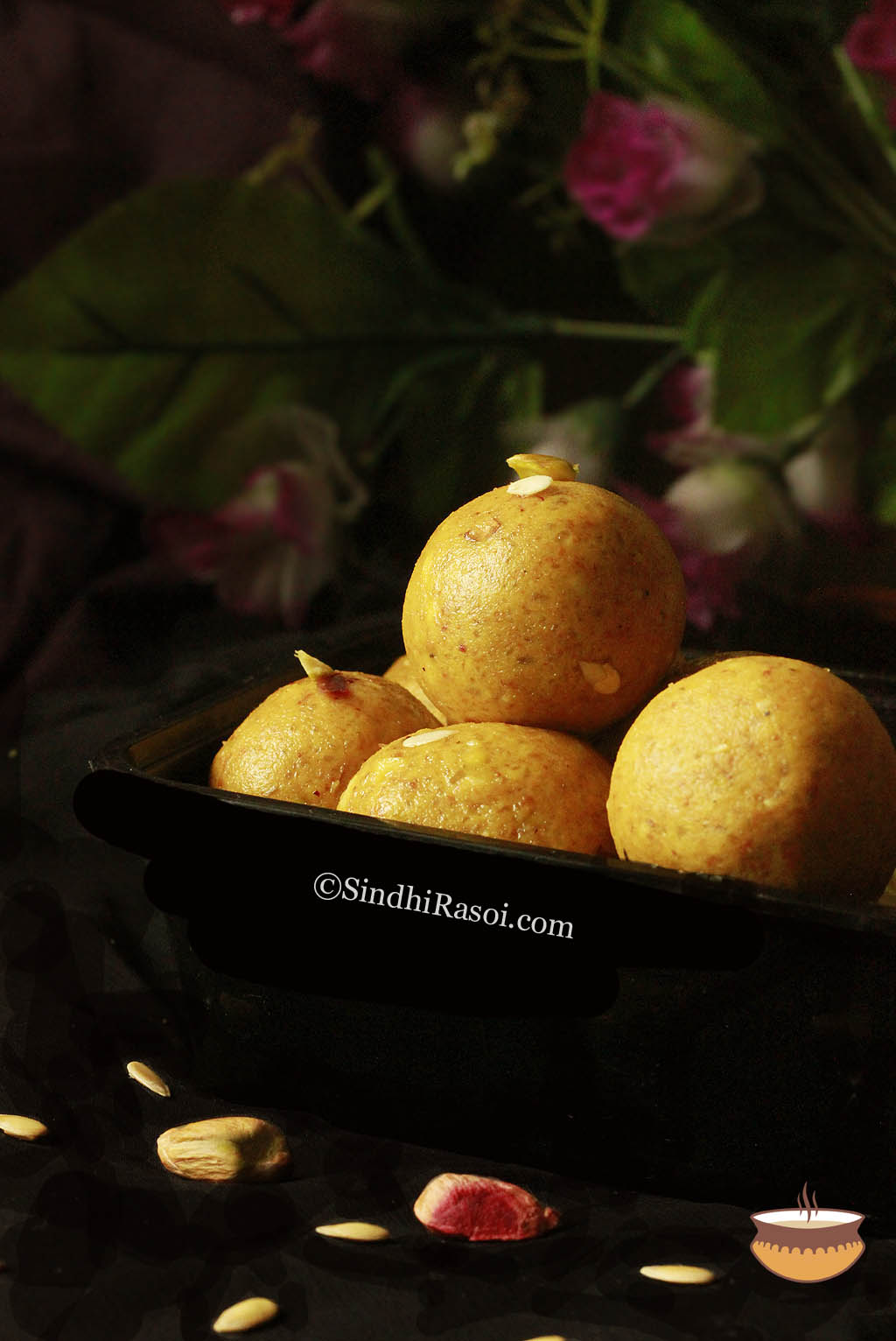
After a lot of brain storming with few friends I finally found a dish and though the name doesn’t begins with G̣ but well… something is better than nothing, no? So here is the corresponding dish…Mag̣az Ja ladoon!

Before I move ahead, I must thank Radha Narwani Artyradz, Surrayya Kapri and Meena B for being there with me in my quest for AlifBe # 32.
We narrowed down to Magaz ( melon seeds) and while discussing the uses of Magaz, Meena B told me about the Magaz (Magaj) ladoo that are distributed in Nathdwara, a popular Vaishnavite shrine of Shrinathji, the deity worshipped by Vaishnava sect, known as the Pushtimarg.
Thathai Bhatia Sindhis too are the followers of ShrinathJi. You can read more about Thathai Bhatia Sindhis here!
She shared few pointers and of course I did check Panja Khada , trusted for traditional Thathai Bhatia style recipes and realised that the Thathai style Magaj (Magaz) ladoo are same as the Gujarati style Magaj Na ladoo.
Magaj (Magaz/Magad/magas) Ja ladoo are named so because traditionally melon seeds, almonds and pistachios were used in these ladoo along with roasted gram flour, ghee and sugar.

One can use just almonds or pistachios and yet these will be Magaz ladoo since even Almonds and pistachios are seed kernels and not nuts as many of us assume. Learnt this fact from my friend Kurush Dalal during one of his mind blowing ‘#know your ingredients‘ Insta live sessions.

Here is how I made these delicious, aromatic and nutritious Magaz Ja ladoo!
Recipe of Magaz Ja Ladoo:
- 3 cups Jada Besan (Magaj flour)
- ¾ of a cup of Ghee
- 1 Cup Sugar
- 2 tbsp Milk
- 3-4 green cardamoms
- ½ cup Almonds and pistachios finely chopped or pounded
- ¼ cup of Char magaz (melon seeds)
- To make Magaz ladoo always try to use Magaz flour or the coarse gram flour. It is easily available in grocery stores generally. But I was unable to procure it on time ( blame it on frequently changing lockdown timings) and hence used the regular gram flour, milled in the local flour mill (avoid the packaged besan as it may have matar flour mixed.)
- In a parat or wide plate/thal, put 3 cups of besan.
- Take 2 tbsp of hot milk and 2 tsp of ghee (from the ¾ th cup of Ghee) and pour it over the besan.
- Now gently massage the flour in a way so as to coat the flour with milk and ghee mixture. The idea is to make the flour crumbly.
- Take a sieve with fine mesh, used for sieving flours. Sieve the crumbly besan through this mesh and keep pressing the flour with your palm or with flat base of a small bowl, till whole mix is sieved.
- Be very patient. This process takes some time and you may not be able to sieve all of it. Transfer the un sieved flour in a blender jar and give it a blitz. Add it to the sieve and continue the process.
- You will now have a flour of uniform consistency.
- In a thick bottomed pan, heat the remaining ghee and transfer the sieved flour.
- Keeping the flame on medium to low heat, roast the flour, stirring continuously.
- This process will try your patience but remember there would be delectable besan ladoo at the end of the tunnel 🙂
- Do not increase the flame or leave the flour unattended. Even slightest over roasted bits may make the ladoo bitter.
- If the mix feels too dry add a tbsp of ghee but mostly it wont be required.
- Gradually the mix will change the texture from coarse/dry to fluffy, slightly frothy.
- At this stage sprinkle few drops of water and mix vigorously.
- Continue cooking for a while and then again sprinkle few more drops of water.
- It took me almost 28-30 minutes to roast the besan, on really low flame. The time may vary depending upon the quantity.
- Mix pounded almonds, pistachios and add magaz seeds as well. You can grind the melon seeds and use these in powdered form as well.
- In the meanwhile, grind sugar along with cardamom seeds (use only the seeds and not the peel) and keep it aside.
- Add the powdered sugar and switch off the flame. Keep mixing.
- Some people add sugar (crystals or powdered) after cooling the roasted flour for a while.
- Allow the mix to cool sufficiently and then taking small portions of the mix, give each a shape of round ladoo.
- I got 12 medium sized ladoo from 3 cups of flour.
- The Magaz ladoo are traditionally dryish, coarse and crumbly but these could be smooth and melt in the mouth too, depending on the amount of ghee used and on the coarseness of the flour.
And as usual here is a small video that I have made to help you understand how Sindhi alphabets are written.