The next consonant in AlifBe (Sindhi ‘alphabet’) is ص in Arabic Sindhi, स in Devanagari and in Roman Sindhi it is ‘S’, as in ‘sandook’.
If you have been following the AlifBe Series, you may remember the 10th post in which I have mentioned that in Arabic Sindhi there are three variants of ‘S’ namely; ث , ص, س . Out of these three, two alphabets i.e ث and ص are used only while writing Arabic or Urdu words in Sindhi script while س is used to write words of Sindhi origin. In Roman Sindhi and in Devanagari, these 3 alphabets are denoted with letter S and स (respectively) only.
So while in my 10th Post I did mention that all three variations of ‘s’ are covered under one since there are no Sindhi dishes that start with ث , ص life had other plans for me!
A few days ago my friend Anjali Koli, a fellow food blogger, the spice queen who makes wonderful spice blends, the lady whom you may have seen on T.v (The Great Indian Rasoi, season 2, cooking with Chef Ranveer Brar) wrote a lovely post about a ritual that is common across many communities, on Instagram! She was referring to a post by Shubhra Chatterji (Director, Story writer and Entrepreneur) of The Lost Recipe fame, about the sugar (cones of sugar) being a part of the engagement ceremonies. It was fascinating to know that a Sugar cone/sugar/Misri is a part of Engagement rituals in Koli and in Parsi communities, in Tamil and Kannada culture as well as in Punjabi community.
As we were exchanging our thoughts on that, I realised how Misri plays an important part in Sindhi culture too. And guess what, Misri in Arabic Sindhi is written by using the 28th Consonant in our AlifBe series; ص!

No Sindhi dish starts with this letter so in the past I had made my mind to skip the letter. But today here I am, with Misri!
Though Misri is not a dish per se, but it plays a very important role in Sindhi rituals. But before talking about the rituals or about how the traditional Misri is made, let me share with you some details about the origin of Misri!
Sugar/Misri/Khand!
Some versions of the History say that the crystallised sugar was being made by people of India, some 1670 years ago and that from India, via Buddhist monks it reached to the Emperor of Tang Dynasty (around 1400 years ago). While some believe that rock sugar/crystallised sugar was discovered in Tang Dynasty and from there it spread to Europe (Southern) via Middle East. Perhaps the crystallized sugar in India, then, was brownish in color while later in China they managed to make the white crystals and maybe, since white was considered as a better or more pure version by the folks fascinated by the fairer stuff, it became more popular than the Indian Khand.
Also, many believe that the term Mishri (Misri in Sindhi) comes from the Chinese ‘Mi-Sha-Li’ meaning “sweet-pebble-glassy,” i.e pebble like crystals of sugar and that the word Khand comes from the Chinese word Kan-Di, which in Arabic became Qan-D and Khand in Hindi.But again, there are theories that the Khandsari (crystallised sugar) is originally a Sanskrit word since Khand means ‘portions'(with gaps) or ‘broken’, in Sanskrit.
Do you know that Romans considered Sugar as something that is used for medicinal purposes only? Trust humans to turn something as nourishing as Khand/Misri to something as poisonous as the modern table sugar!
Traditionally Misri is made from Khandsari, the unrefined sugar!
Juice is extracted from sugar cane, boiled with or without Palm sap, some mucilaginous extracts of vegetable plants (Like Okra/ Deola) are added to clarify the juice along with lime juice (not always)till the scum collected on the surface turns white. The juice is concentrated by boiling further and then cooled. But while cooling it is paddled continuously and thus jaggery ‘sugar’ is obtained which is unrefined (technically, bit refined or cleaner). This unrefined sugar is rich in minerals and is not a threat to your health but when this unrefined sugar goes through multiple ‘refining’ processes, we get the table sugar, an unnecessary, totally avoidable ingredient in our pantry, consumed in ample quantities.

To make Misri, a supersaturated solution of the Khand (traditionaly the unrefined sugar) is made and allowed to stand undisturbed.
The popular ‘Dhaage Waali Mishri’ is made by placing a string/thread in the supersaturated sugar solution. As the solution cools down the drier surface of thread is used by sugar crystals as a surface to hold on. Tiny crystals of sugar (also called ‘seeds’) first cling to the thread and as the time progresses and temperature decreases, more and more sugar from the solution turn into crystals and collect on the ‘seeds’ and that’s how we get the threaded crystallised rock candy or the Misri.

If made from unrefined sugar, Misri is actually good for the health.
Importance of Misri in Sindhi Culture:
Since ancient times, Misri is not only used as a sweetener but also as a symbol of sweetness in our lives. Hence it is used in many Sindhi rituals.
Dahi Misri (curds mixed with misri) before venturing out for important work (keeps you cool and provides energy), makhan misri (a must for Bhog to Lord Krishna) are known combinations consumed by people across the communities in India.
Chaato /phook: In olden days, a new born was given a finely sieved, powdered mix of green cardamoms and misri to avoid colic pains. Later (after atleast 40 days from birth) Jwar Ji tikki is added to the same. This fine powder is called Chaato/Fook-a/Phook. Now the Doctors do not allow anything to be given to infants except mother’s milk but some still do follow the tradition!

Similarly, the new moms were fed the Fakki, a powdered mix of digestive herbs, spices, almonds and misri as a part of postnatal care.

Jhand/ Tonsure ceremony: In many Sindhi families (particularly the Shikarpuri Sindhis) a ritual called Chouso Kanjiri is performed by maternal grandmother, where she offers Kopra (dried coconut) and Misri to her daughter (now a mother herself) after the child is tonsured.
Kheer Jalan: Soon after the tonsure ceremony, the child is taken to his/her maternal grandparents for a visit and while returning the child and his/her mother is handed some raw milk and Misri along with new clothes.
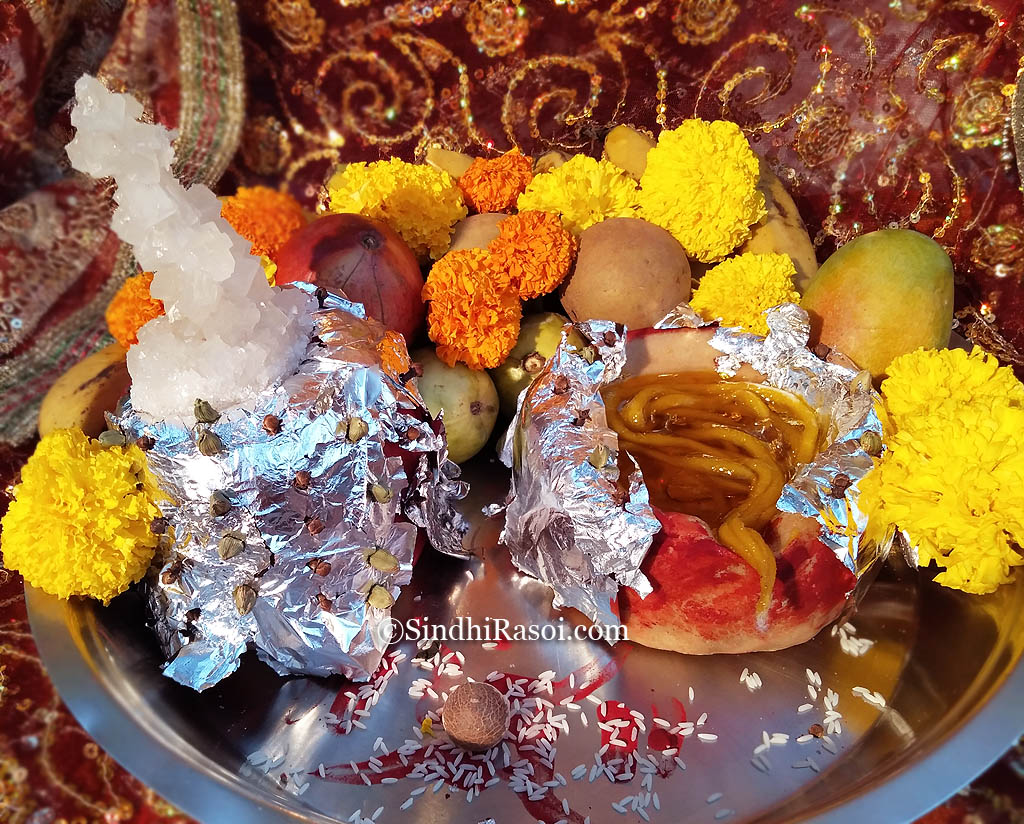
Kachi Misri (Informal Engagement) : When two families agree to a marriage alliance between a girl and a boy, the key members of either side of the families decide upon a date and and an informal engagement ceremony is held, called Kachi Misri. Traditionally some fruits along with coconut and Misri were exchanged but gradually the ritual became more elaborated in terms of the gifts exchanged.
The sister of the boy (future groom) does the key rituals here. She sits next to the girl (future bride) and a red dupatta is used to cover their heads. She then feeds the girl some Karao/ seero (Wheat flour halwa, or could be Suji halwa) and places coconut, 5 fruits and Misri in the extended or stretched dupatta/ sari pallu worn by the girl. Some consider it as a gesture of accepting the girl in the new family while others believe the ritual to have deeper meaning i.e the coconut is considered a symbol of fertility and a blessing of Lord Shiva, the Misri is for blessing the couple with ample sweetness in their future life, the fruits are to wish health and happiness.
The families then exchange the baskets filled with fruits, dry fruits and nuts, mithai and in modern times, even packaged snacks and everything is then shared with extended family members.
The ritual varies from family to family but the crux is same i.e Misri is exchanged for the informal engagement.

Before marriage another ritual called Pakki Misri (or Pakka) is performed which is the formal engagement and generally rings are exchanged during this ceremony. Believed to be adapted from Western culture, Ring ceremony nowadays is more about Cocktail parties and elaborate buffet meals with DJ music and all. Times are changing and how?

Ddikha: Traditionally observed on the eve of the marriage, or just before the wedding this is one of the most important ‘pre marriage’ rituals.
The ladies in the extended family of the groom make a Boshshni for the groom. It is basically a plain white cloth which is stitched at one end in a way that it forms a pouch. The stitching is done using needle and thread by the aunts/sister-in-law or ladies in the family and some light embroidery is also done by them.

This Boshshni is then draped around the neck of the groom and Misri, coconut/fruits are put in the ‘pouch’.
This is again worn during wedding (Pheras) by the groom and is also used in important events/Pooja ceremonies later, particularly during Tel , a ritual performed in pregnancy (like Baby Shower in the West) etc.

Vanva Ji kutti:
On the eve of wedding or as some observe it on the day of the wedding, the bride and groom are fed a nourishing crumble of coarsely pounded (or ground) dry fruits, cardamon etc to which misri is also added.

This nourishing Kutti (Kutti= Something that is pounded) is fed to the girl and the boy by their respective families and is also fed to eligible bachelors with the belief that eating it would bestow good luck and fortune in terms of marriage prospects.

Behrano:
A Behrano is a a sacred ritual observed by Sindhis in honor of Lord Jhulelal. It is generally made on ChetiChand (New Year of Sindhis) or during Chaliha festival (A fasting festival observed for 40 days by many Sindhi devotees) or on some other auspicious occasions.


Finally the Behrana is immersed in the river or lake and a small Pooja is done. Sindhis used to live around the Indus river and would often travel far and wide through sea routes hence water bodies were worshipped and fishes were (and still are) often fed with rice, kneaded dough, misri etc.
I may have missed some rituals where Misri is used. If you know of some such traditions and customs please do let me know in comments section. I will add that information to this post with due credits.
I cannot wind up this post without thanking my dear friend (a true friend in need) Pooja Juriani, for her extreme generosity and timely help. Without the pictures shared by her, this post would have been dull and lifeless! Thank you Pooja Juriani, for patiently hearing me out and for the countless pictures that you shared so that I can pick some from your collection. Heartfelt Gratitude!!!
And before I end up this long post, here is the link of the video about the consonant ص

my daughter is getting married to a sindhi boy. I need to know all the things required for kachi mishri rasam. I will be very thankful to you if you respond and help me doing the first rasam nicely as we are punjabi and not aware of sindhi culture.
I have sent you an email regarding the same. Please go through it and do let me know if there are any other queries.
Loads of love and wishes for the dear daughter!
can you send me too..
Archana1971@gmail.com
Jai Jhulelal Thankyou for the valuable information.. pl could you guide me of a ritual I heard about if a lady becomes par dadi.. great grandmother she is gifted some Payal or jhanjhar … pl would be grateful if you could help me
Jai Jhulelal!
The rituals vary from home to home. I haven’t heard of such a ritual but would surely check with other Sindhis and let you know.