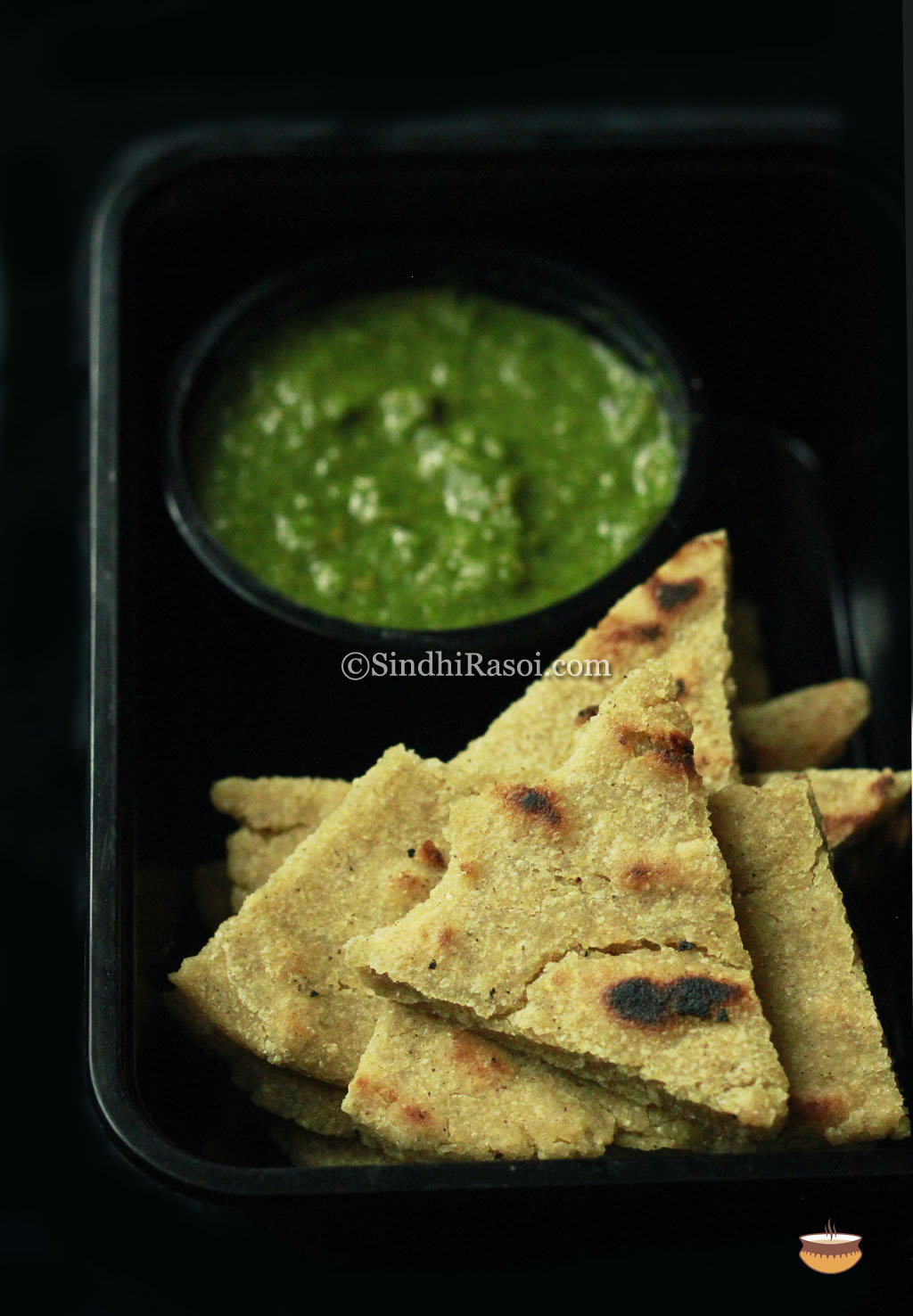
Parsad (Prasad or an oblation) distributed in Sindhi temples or Tikana could be as unpretentious as Misri (rock candy) or as eye appealing as D^othee , it could be as sacrosanct as the Karah parsad (Kadah Prasad) or as revered as the Dona parsad of the Puj Chaliha Sahib Mandir (in Ulhasnagar).
Mostly anything sweet is offered to the deities and a prasad is generally made from different kind of flours, ghee, sugar, jaggery, used in various combinations and proportions and cooked in varying ways to make sweets of infinite flavors and textures. Fresh fruits too are abundantly distributed in temples! The basic concept is to offer a devotee, visiting from far and near, some food that is either a source of instant energy or some nourishment or both.
Many devotees visit temples early morning before consuming anything and hence breaking a night long fast with some Kada prasad, daakh bugada (black raisins and roasted chana) or a fruit is an ideal practise followed by many.
In the modern era, not many understand the basis of the rituals and hence it is not uncommon to find packaged food and junk being served in the name of prasad by the devotees.
So while the sweets and fruits are immensely popular, there is a unique prasad, the Dhodho Chatni, that is served in Sri Sadhu Bella Ashram, also known as Sadh Belo, meaning the ‘Woods of the Sage’ or the ‘ Hermitage of a Monk’, founded by Yogiraj Sadguru Acharya Swami Bankhandiji Maharaj in the Year 1818 A.D. at Mahalakshmi, Mumbai!

I am thankful to Mr Prem Hariani and Mr Ashok Lalwani for sharing with me, the history of Sri Sadhu Bella Udasin Ashram along with interesting anecdotes (that I plan to share in the near future) and I am looking forward to learn more about this wonderful place of worship, from Ashok Ji, in the coming days, as promised by him!
Ashok Ji told me that the Parsi Philanthropist, Dadibhai Noshirwanji, popularly known as Dady Seth, as a token of gratitude for Sadguru Bankhandiji Maharaj, donated a sprawling plot of land in Mahalakshmi area in Mumbai and the Ashram was then made on that piece of land. The ‘Dhooni’ (sacred flame ) lit by Acharya Bankhandiji Maharaj in 1818 A.D. is still burning there, spreading the message of peace, empathy and spirituality .
In around 1823, Sadguru Bankhandiji Maharaj moved in a forested Island called Menak Parbat, in Indus river, Sukkur (Now in Pakistan) and built a simple hut, which over the years, was reconstructed in a magnificent shrine built with white marble and buffed sandstone and was named Sadh Belo.
Bankhandiji Maharaj belonged to Udasi panth, a sect that flourished under the reign of Maharaja Ranjit Singh in late 1700s. The founder of Udasi panth, Baba Sri Chand, the eldest son of Shri Guru Nanak Dev Ji, believed in monasticism i.e living a disciplined life devoid of materialistic pursuits while being spiritually devoted and hence the followers of the sect detach themselves from the worldly pleasures.
Bankhandiji Maharaj, one of the greatest visionaries of the 19th century is remembered and respected for his spiritual prowess and the Sadhu Bella is a medium for spreading peace and spiritual wisdom!
And as I mentioned above, Sadhu Bella is also well known for its divine prasad of ‘Dhodho Chatni ‘ i.e patted Sorghum roti with green chutney.

This prasad combination is also served in many Tikana. A Tikano is a place of worship where you will find idols of many deities along with Guru Granth Sahib, teaching us to co-exist harmoniously.
Mr Ashok Lalwani confirmed that this prasad (or Parsad) is made without onions or garlic.
The Dhodho Chutney Parsad at Sadhu Bella is a fine example of how the simplest of foods, without overpowering ingredients, if cooked with devotion and gratitude can satiate your senses and nourish your body and soul!
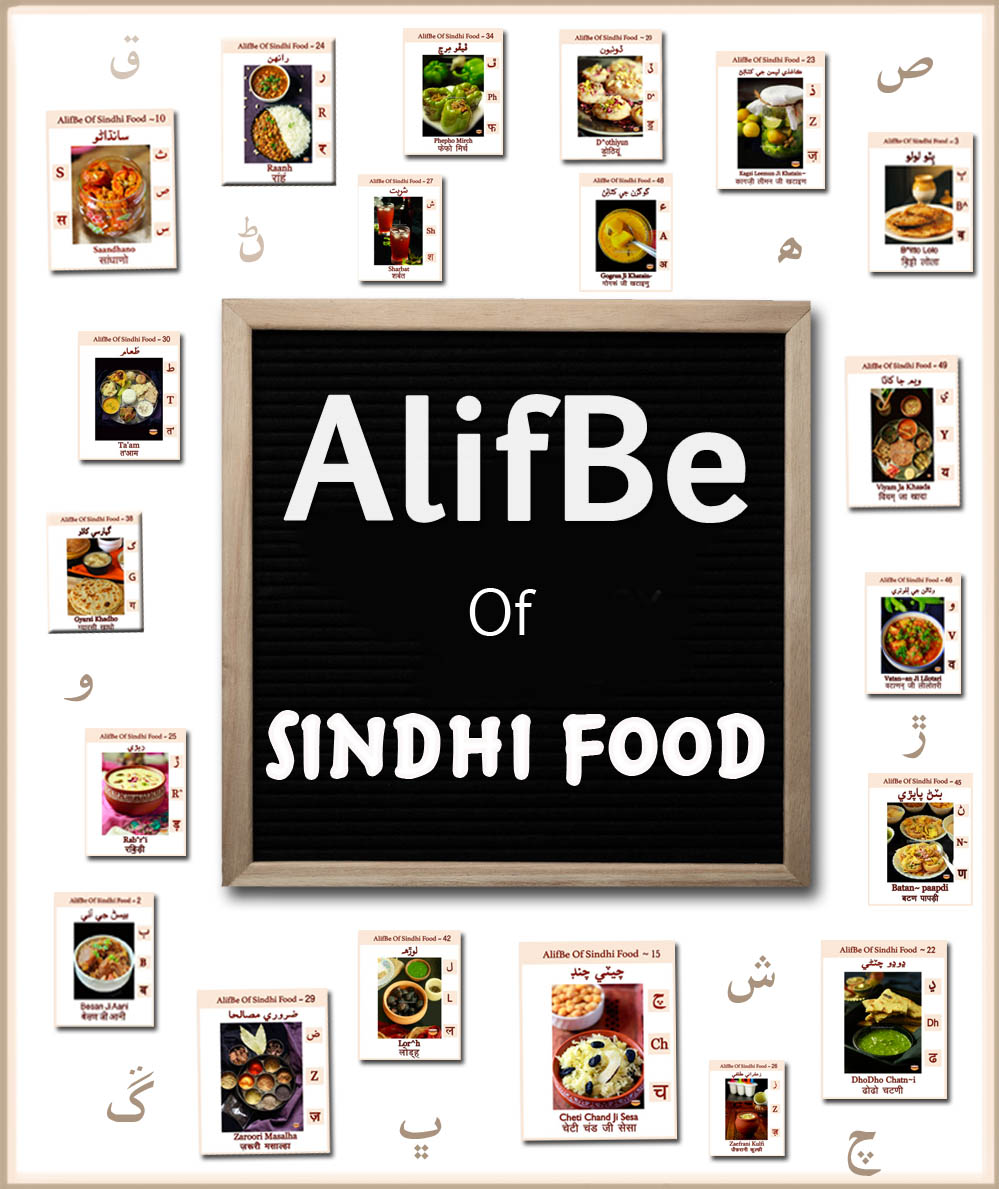
And with this Dhodho Chatni we are covering the 22nd letter of the AlifBe series which is ڍ in Arabic Sindhi and ढ in Devanagari. In Roman Sindhi it is Dh as in Dhaka/ or Dhokla.

The Dhodho Chatni at Sadhu Bella is satvik but at home you can add pounded garlic, chillies and chopped onions along with coriander leaves while making the Jowar dough. Also you can add onion and garlic to the green chutney.
Do share your memories about having this prasad or any of your favorite Prasad from any temple, in the comments ! Thanks in advance!

- 1.5 cups of Jowar flour
- Salt as per taste
- 1 tsp ghee or oil
- Water to make the dough
- 3-4 tbsp ghee or oil to cook the rotis
- 1.5 cups coriander leaves
- ¾th cup Mint leaves
- Black salt/Rock salt ½ tsp
- Roasted cumin seeds ½ tsp
- Black pepper corns 4-5
- Green chillies 3 or as many needed
- A half inch piece of ginger
- Tamarind (ping pong ball sized) soaked in 2-3 tbsp of water
- Sendha namak or regular salt as needed
- In a parat/thali or a large bowl, add jowar flour, salt and a tsp of ghee. Mix everything and gradually add water, a little at a time and bring the flour together to make a dough. No need to knead the dough.
- Make sure the dough is pliable. Divide the dough in to two portions.
- Heat a flat griddle .
- Take one portion of the dough. First bring together the dough to make a ball shape, flatten it in between your palms and then place it on the hot griddle and start patting the dough in circular motion ( can refer this video) to make a thick roti. Alternatively you can cut open a ziplock bag or take a (transparent) plastic sheet and pat jowar roti on the sheet and transfer it carefully on the hot griddle.
- Allow it to cook on one side for a minute or so and then flip over. Smear some ghee or oil and flip again after few moments. Cook till done.
- To make chutney just blend all the ingredients (listed under 'For Green Chutney') to make a smooth paste. Taste and adjust seasoning, if needed.
- You can add a tbsp of dalia dal or even some thin sev to the chutney.
And for those who may be curious about how to write in Arabic Sindhi script here is a short video for today’s alphabet ڍ

can you please share the recipe of Maakhni dal which is served with dal samosa and dal sandwich at Jai shankar doli nashta (3 number)
I think it’s made with moong dal but not very sure about it. also their green chutney is out of this world. if you know the recipes, please let me know.
The dal is plain Mung dal (Mung dal yellow). First you need to soak the dal for atleast half an hour. Then in an open pan boil the dal with salt, water and turmeric till buttery smooth. The flavors come from slow cooking the dal. We, at home just add freshly pounded black pepper along with some ghee/ butter but you can give a tadka of red chilli powder.
The green chutney is regular mint coriander chutney with extra tamarind juice. Also, I guess they have a separate tamarind chutney too (not sure about the Doli but ma y other vendors do use that)….tamarind juice with hint of ajwain, kaala namak, bhuna jeera powder, pinch of hing, sugar etc.