Today (13th April 2021) is Cheti Chand and we, the Sindhis, celebrate it as our New year, with great enthusiasm.
Why do Sindhis Celebrate Cheti Chand?
The legend says that people in Sindh (Now in Pakistan) were tortured by an arrogant ruler named Mirikshah who tried to force Hindu Sindhis to accept Islam.
Sindhis being followers of Varun Devta, Lord of Waters, gathered on the banks of holy Sindhu (Indus) River and prayed for some miracle to save them. After fasting and praying for many days there was an akashvani that the Lord Vishnu will soon take birth in an avatar of a child to a couple; Rai Ratan and Devaki, at Nasarpur.
So the Sindhis went to Mirikshah and requested him to grant them few months to accept his order. The over confident ruler obliged.
And as predicted, in the Chet (Chaitra) month a child was born to Devaki Ma and was named Uderolal.
To offer their gratitude, Sindhi folks marched towards the river carrying sweetened rice, boiled chole (kabuli chana) and milk to feed the fishes/sea creatures.
And as we all know, the child grew up to save Sindhis from tyrant rulers and was later known as Jhulelal!
And the birth of Lord Jhulelal is celebrated as Cheti chand.
Since then, every year Sindhis gather on Cheti chand and processions are held by carrying Behrana Saheb to any local river or lake, just like the people did in olden days, as per the legend

To make Behrana, a bronze Thali ( or a steel thal) is taken and some raw rice, sugar or misri, ghee and little kumkum is spread. A huge mound is made from atta ( kneaded dough) and is placed on the thal. The mound represents Lord Jhulelal. The mound is then smeared with sindhoor/Kumkum (please donot use chemical loaded Sindhoor) that represents clothes of Jhulelal saeen. Laung (cloves) and Nanda phota (green cardamom, ideally 101, but the count varies) are stuck in the mound .These spices represent ornaments of Lord Jhulelal . A block of Misri i.e crystallised lumps of sugar are placed at the top of the mound.
A lamp of dough is made (mostly panchmukhi i.e having five edges to place five cotton wicks or Chaumukhi i.e 4 edges) and filled with ghee. Fresh flowers, fruits (5 types of fruits) and some red cloth is also placed in the thal.
This Thal is placed in front of an idol or picture of Lord Jhulelal and hymns are sang to praise the Lord. A Prasad of sweetened rice (Tayri) and boiled chole is distributed. Many Sindhi people and Sindhi Associations organize langar/ buffet meals for the devotees gathered for the occasion.
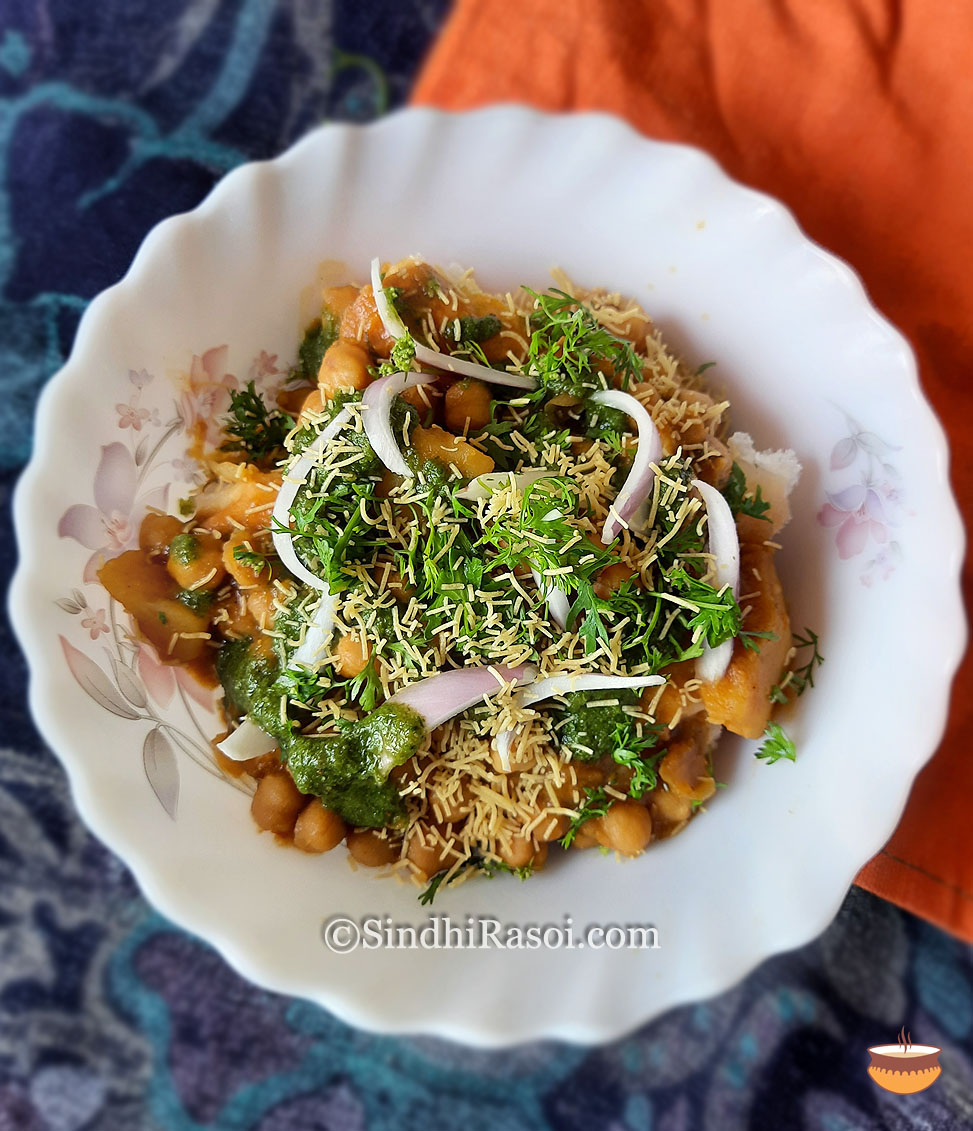
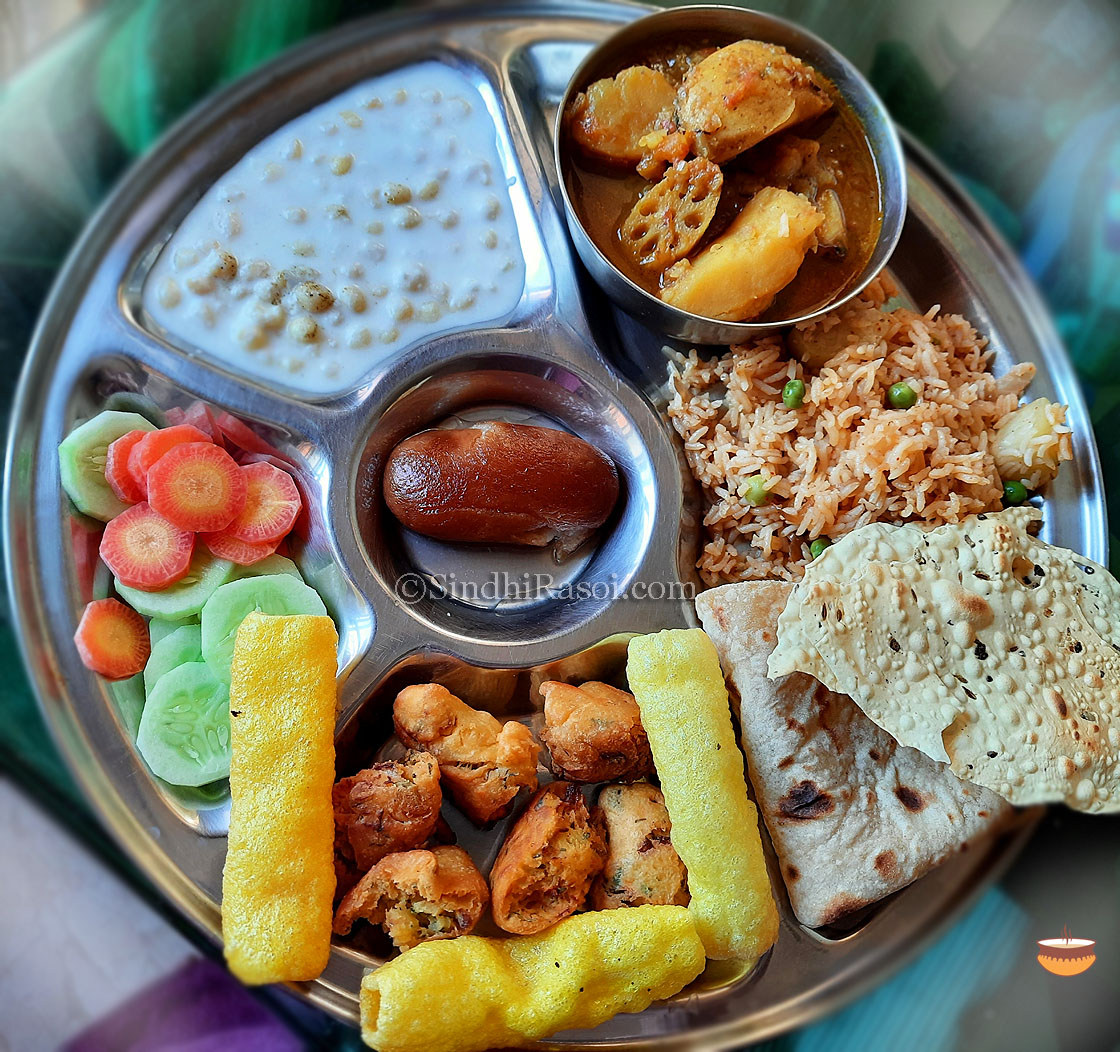
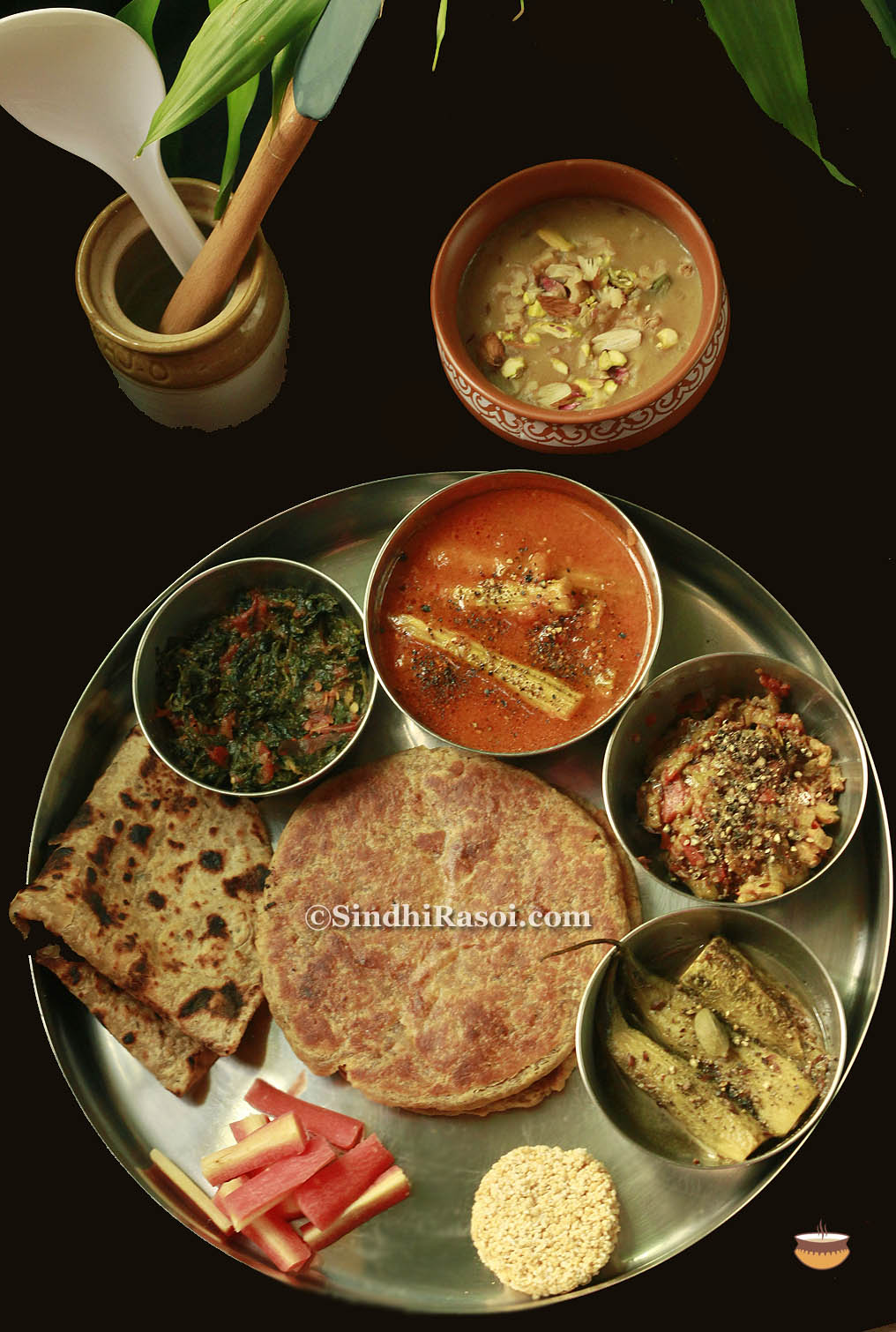
The Behrana (always carried on head), along with a Pooja Thali (coconut, dough lamp, agarbatti, flowers, kalash filled with water) is then taken to a river body and people dance and sing and pray on the way. Sindhis call it ‘ Chej’. Many Prasad counters on the way distribute Tayri, chola, raanh (black eyed beans), pulav, sherbet, milkrose, chanadal bread, bread pakora etc.
 Finally the Behrana is immersed in a river or a lake and a small Pooja is done. Bhajans are sang and the ritual ends with an Aarti and Palav (a small prayer recited while holding out an open end of duppata or a shirt or a hem of kurta/garment to make a jholi).
And for 15th letter of Sindhi AlifBe i.e چ , ‘Ch’ in Roman Sindhi and च in Devanagari I have picked (but obviously) ‘Cheti Chand Ji Sesa’ i.e Prasad offered and distributed on Cheti chand.

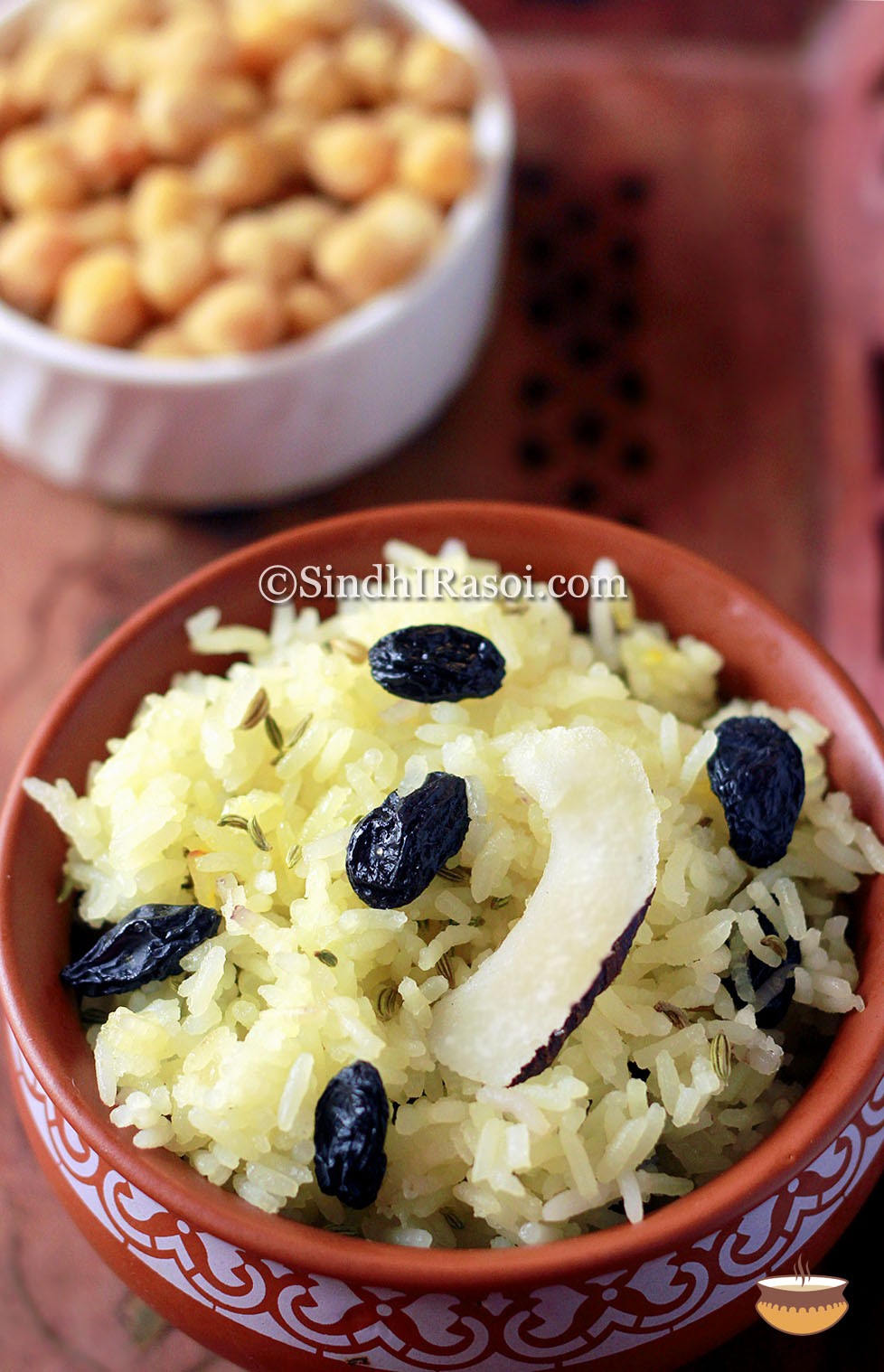
Tayri/Tahiri/Tairi (sweetened rice) and boiled kabuli chana, both are mandatory to offer to Lord Jhulelal and the devotees love this Prasad!

Chola or Kabuli chana are simply boiled with water and salt till very soft. Generally it is not garnished with any spices.

Also Kohar i.e black vatana, boiled till tender, are also distributed.
Wishing everyone a blessed year ahead. Cheti Chand kyun lakh lakh wadhayun (millions of good wishes for Cheti Chand)!
Jai Jhulelal!!

Prep time:
Cook time:
Total time:
- Rice (Basmati or regular) 1 and half cup
- Sugar ideally 1 and half cups but I used 1 cup of it. You can use jaggery instead
- Water 3 cups ( varies with variety of rice used)
- Saunf (Fennel seeds) 2 tsp
- Dhoongi ( Dried coconut kernel/kopra/copra) few thin slices
- Draakh/Daakh (Black Raisins) 2 tbsp
- Oil/Ghee 1 tbsp
- Green cardamoms 2 (optional)
- Roasted/fried dry fruits/nuts like almonds, unsalted pistachio/cashew (Optional..I didn't used any !)
- Saffron - few strands
- Orange red/ orange yellow/Jalebi colour few drops (I didn't use any !).
- Rinse well and soak rice for half hour.
- In a tsp of water or milk soak saffron strands, if using.
- There are two methods of cooking rice. One, you can simply boil rice with water and other is that you first heat a tbsp of oil in a pan , add soaked and drained rice and gently roast it for few minutes. Then add water to cook rice. I have skipped the bhunoing part!
- Boil rice with water (you can add a pinch of salt) on high flame till the grains swell.You can add green cardamoms too.
- Cook covered till almost 75 % done. Drain excess water if any, to avoid overcooking.
- In the meantime, roast/ fry, nuts/almonds (if using).
- Heat a tbsp of oil in a small pan and add thin slices of Copra (kopra) and black raisins.Put off the gas and immediately add fennel seeds.
- Add sugar (or jaggery), soaked saffron and the kopra+raisins+ fennel mixture upon the rice and cook on lowest flame.If using food colour, add it at this stage. The liquid colour could be used as it is, while if using food colour in powder form then dissolve it first in a tsp of water and then add in rice.
- You can use a griddle and place the rice container over the griddle and cook on lowest flame.The rice must be covered with a lid at this stage.
- Mix very gently (just once) and cook till the sugar melts and is absorbed by rice.
- Tairi cooked with using colour is generally orange in colour. If cooked with organic jaggery, it is brownish in colour, if cooked using normal jaggery and sugar or just sugar, it is pale white in colour while if saffron is used it gets yellowish hues.
And here is a short video to help you understand how چ is written in Sindhi!