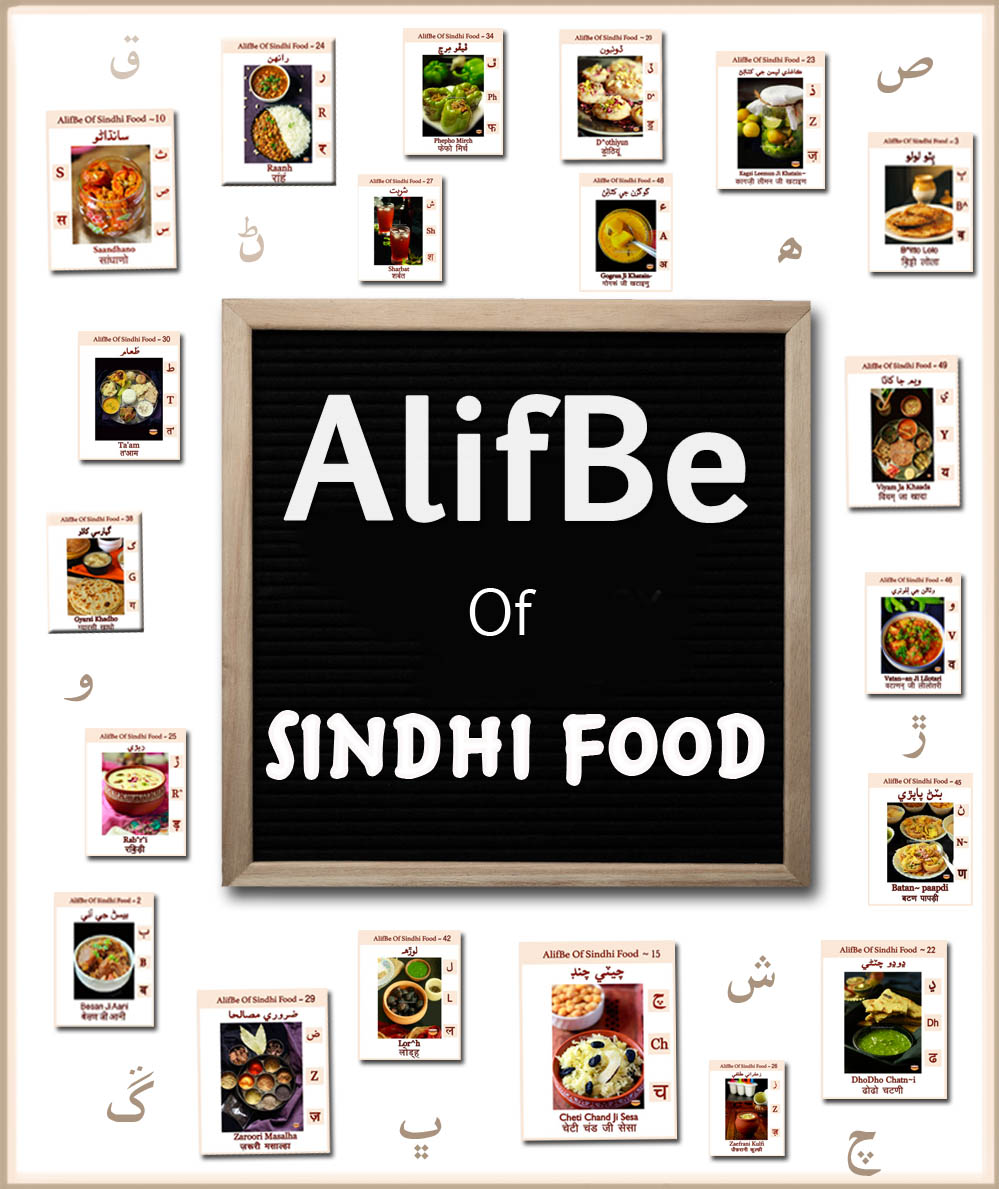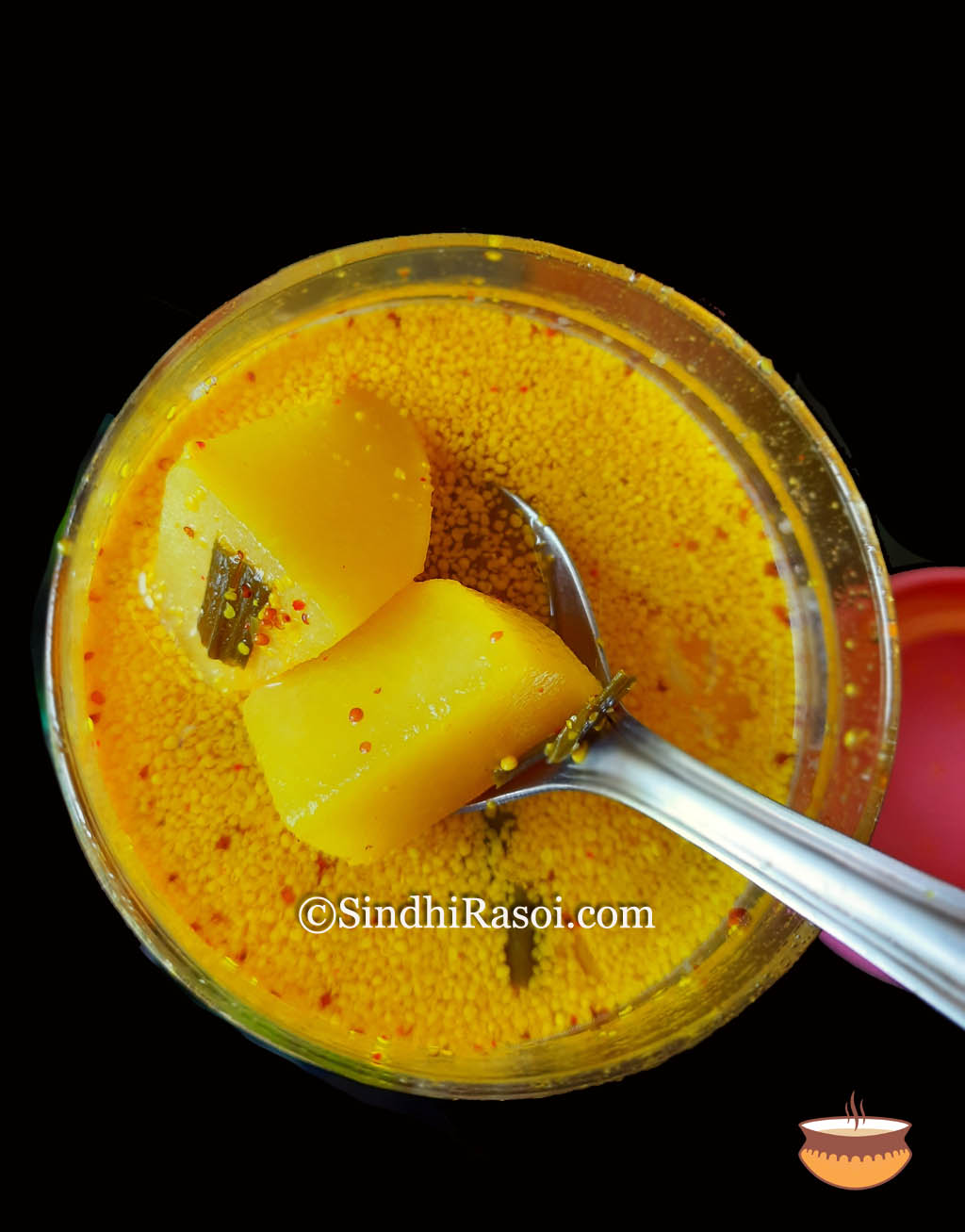
Moving alphabetically in AlifBe of Sindhi Food series, we are now at the 9th consonant! Before talking about the AlifBe alphabet of today or the corresponding dish, let me share some memories with you!
In 2011 and 2012 I got some back to back opportunities to meet the celebrity chefs like Chef Vikas Khanna, Chef Kunal Kapoor and Chef Ajay Chopra for various events during, as well as after the MasterChef India season 2. And that’s when I got a chance to meet and interact with Chef Sanjeev Kapoor too. Then there was a Food bloggers’ day celebrated in 2012 where the selected bloggers were invited by Chef Sanjeev Kapoor in his office. An awesome experience it was!
The unending conversations revolved around food (but ofcourse), the diversity of Indian food and the beauty of regional cuisines. We discussed the best places to eat Sindhi street food and about how divided the world is over vegetarian and non vegetarian food. Chef Sanjeev expressed his love for Sindhi Kadhi and that’s when he mentioned Bhatia Kadhi. He also mentioned Mr Bharat and his book/blog (I don’t exactly remember) about Thathai Bhatia food but I had that perplexed look on my face and he finally gave up!
Eventually when I began my research on lost or lesser known Sindhi recipes this wonderful website (the same one that Chef Sanjeev spoke about) called Panja Khada became my source of information about Thatthai Bhatia food.
My curiosity was further fanned by Meena Bhatia ji, whom I came across via SindhiRasoi Facebook group and she kept enlightening me about customs and traditions, food habits and food rituals of Bhatias/ Thathai Bhatias!
And once I started interacting with Mr. Bharat Chahchara (of Panja Khada Fame), I realised that the world is yet to explore this humble yet remarkable cuisine.
But before I talk about the cuisine let me share a brief history of Thathai Bhatia community:
Thathai Bhatias take pride in their ancestry!
Before the Muslim invasion the West and (most of the north) of India was ruled by Rajput dynasties. Being from the Kshatriya varna (social order) originally, the folks from ‘Bhatti’ community used to work with the Rajput army in Jaisalmer. The Rajput Bhattis were the rebellions who conquered areas around Delhi after the death of Iltutmish, the third of the Mamluk Kings who ruled part of Northern India.Rajput Bhattis gave a tough time to the rulers of Khilji and Tughlaq dynasties who ruled over the Delhi Sultanate in medieval India. Later families from Bhatti community who eventually settled down in Thatta, which was a medieval capital of Sindh ( till 17th century), were then known as Thattai Bhatias.
The community then moved to Gulf countries, particularly Bahrain and Dubai, for better prospects and yet they hold on to their roots, their culture and their cuisine!
So how same and how different are Thathai Bhatias from other Sindhis? How different is their cuisine? What are their food rituals? I had so many questions on my mind when I approached Mr Bharat Chachara to enlighten me about the T. Bhatia Community. Despite his stature, his busy schedule and his social commitments, he is so approachable, humble and ever willing to share his knowledge about the food and rituals of Thathai Bhatias!
Here are some basic queries that I had for the community and the brief details that Mr Bharat Chachara shared!
Q) Ancestry of Thathai Bhatia Sindhis !
Bharat.C: Thathai Bhatias are originally from the Bhatti clan from Jaisalmer in Rajasthan. In the 15th century, they helped the king of Thatta to help quell a rebellion from his citizens. Grateful, the king asked them to settle down in Thatta. Over a period of time, the Bhattis became Bhatias and because they were settled in the province of Sindh, they came to be called Thathai Bhatias.
Q) Why Thathai Bhatia Sindhis don’t use onions and garlic in their cuisine?
Bharat. C: In the 18th century, the Thathai Bhatias adopted Pushtimarg – and became Vaishanavs. They worship Shrinathji (The child form of Lord Krishna). The seva of the Bal Krishna is done in every household. It is a belief that the lord does not like pungent food – which is why onion and garlic is refrained from being used in the cuisine.
Q) When did you start the blog Panja Khada? Can you recall the exact moment when you decided to blog about this lesser known cuisine?
Bharat. C: We (Bharat and his wife Deepa Chachara) launched our book Panja Khada in the year 2002. It did quite well and over a period of time, enquiries about the book started coming in from all across the world. We also wanted to add more recipes and keep updating it on a regular basis. It was not possible to keep printing books. So, in 2010, we launched the website – panjakhada.com – this website is easily accessible and informative and hence serves the purpose of spreading the awareness of the Thathai Bhatia cuisine – it also is updated on a regular basis.
Q) What are the most commonly used spices/ingredients in T. Bhatia style food?
Bharat. C: Spices like asafoetida (Hing), Cumin seeds (jeera), Mustard seeds (Rai) are used extensively in the cuisine. Apart from the medicinal values, these serve as a substitute to onion and garlic.
Q) What are the dishes that are cooked on regular basis in a T. Bhatia household?
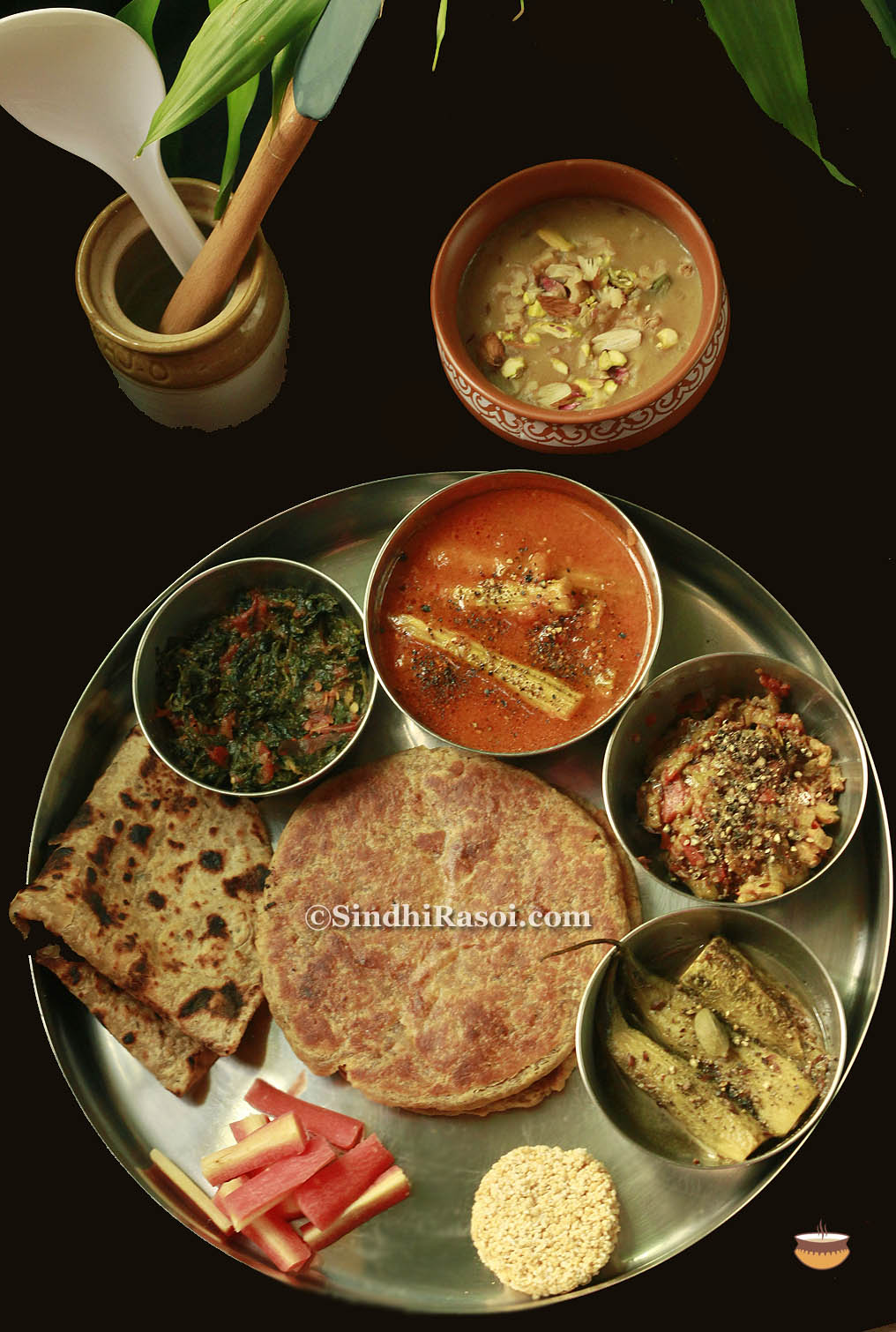
Bharat. C: Dal, Bhaat, Kadi (Rice topped with Lentil served with Bhatia curry), Chiblaro (Bhatia Vegetable Pulao), Tari – Poath (Sweet Saffron Rice served with Lentil Curry), Maghamethi (Moong & fenugreek curry) are common lunch items.
For dinner rice is not served – usually Phulko (Bhatia Chapati) or Chapri (Red Rice Flour Chapati) is served with a Sabzi. Vanghar (Aubergine) is used extensively in the cuisine and is consumed in different styles – fried, spicy, salted, sweet, in a curry or a dry form.
Q) Are there any food centric festivals in the Thathai Bhatia community?For example many Sindhi subcastes celebrate Thadri festival when a day old food is had!
Bharat. C: We have the same, which is called Thado (meaning cold) where cold food is eaten. All the festivals have food specialities which are to be eaten on that day – like on the day of Dhurio (day Holi is played) – Moonga Choka Curry or Tari Poath is served or on the day after Diwali when Nayo Saal (New year) is celebrated we have Anakoot – where 56 items are prepared. There are other beliefs also like on Wednesdays, Maghamethi should be eaten as it brings barkaat (prosperity).
Q) Any popular/unique food gifts that are exchanged on specific occasions like birth, marriages etc? –
Bharat. C: When there is a special occasion in the family like a birth or engagement or a marriage they tie a Paar (a piece of cloth is put around the neck and the open ends are spread out, like a Jholi, to accept food offerings) and food gifts like coconut, ladoo or santa (a sweet) are put in the paar and later distributed to friends and family!
There is so much more I wish to share about this lesser known cuisine so may be I will include few more dishes in my future posts of Alif Be series.
Which reminds me that we are now at the 9th Consonant of Sindhi Alphabet, the AlifBe, and it is ٺ i.e ‘Th‘ as in Thakur (ठाकुर) Thug (ठग) or as in Thikana (ठिकाना) , ठ in Hindi/Devanagari!
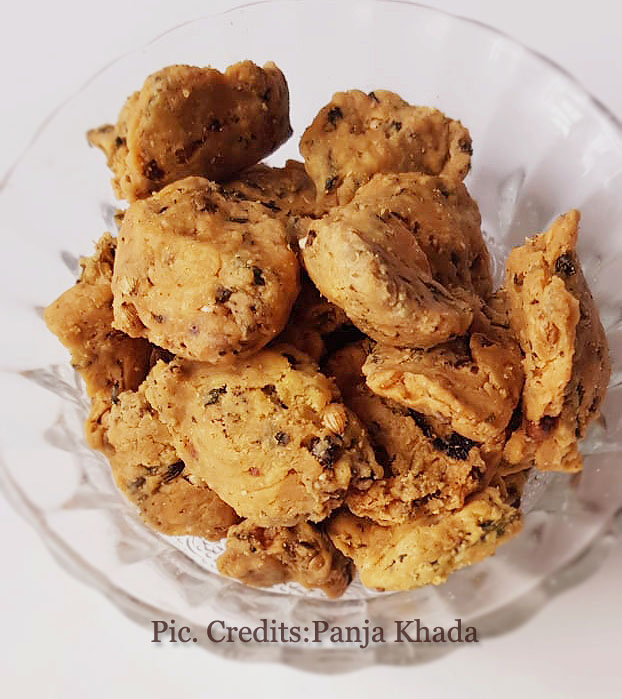
I had a tough time finding a Sindhi dish starting with ‘Th’ but guess what ? There is a dish in Thathai Bhatias’ food repertoire that starts with this unusual consonant and it is called Thab^ak vadiyun, the spiced, crisp fritters with a longer shelf life than regular pakoda (Pakode). Vadiyun are wadi or fried dumplings while Thab^ak, according to Bharat ji, means ‘pressed’ or ‘flattened’ (or to press/flatten)!
So yes, it’s Thabak Vadiyun for AlifBe of Sindhi Food # 9!

The recipe and the picture of the dish; both are shared by Bharat Chachara from Panja Khada!

- Bengal Gram flour – 1 cup
- Whole Wheat Flour – 1 tblsp.
- Green Chillies – 3 – 4 nos.
- Dried Fenugreek leaves – 2 tblsp.
- Coriander powder – 1 tsp.
- Oil – 2 tblsp.
- Oil – for frying
- Salt – to taste
- In a toap (vessel), combine Bengal gram flour, whole-wheat flour, salt, chopped green chillies, dried fenugreek leaves and oil. Mix well.
- Add water to make a very thick batter of pouring consistency.
- In a kadai (iron wok), heat the oil for frying. Take some batter with the hand and pour it directly in the kadai. It should be round in shape. Let the Variyun fry in oil until it is golden brown in color.
- Remove the Thabak Vadiyun, drain off the excess oil.
- Allow them to cool. Store in an air tight container.
- Traditionally, Thabak Vadiyun are served with Naram Khichdi (rice & lentil porridge)
Heartfelt thanks to Mr Bharat and his better half; Deepa Chachara for their efforts to preserve the culture and cuisine of Thathai Bhatia community!
Please do check Panja Khada website and subscribe to their youtube channel, Buzzing Recipes , to know more about Thathai Bhatia community!
And before I sign off for today let me share a small video about how to write ‘Th’ in Sindhi!