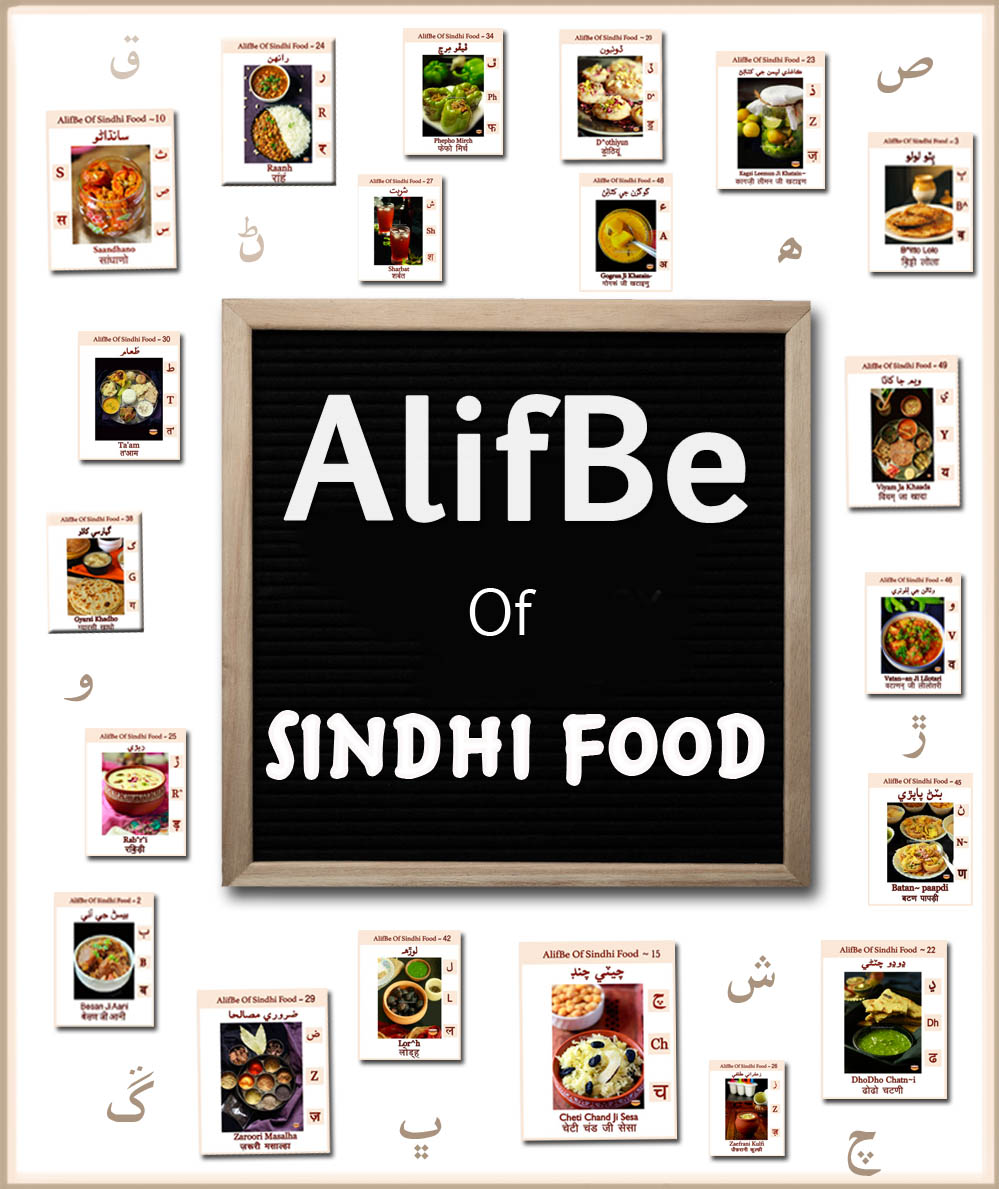
The 7th Consonant in AlifBe i.e the Perso-Arabic Sindhi script (Alphabet) is ٿ which is थ in Devanagari while in Roman Sindhi it is written as Th~ i.e by using a Tilde (~) as suffix as we don’t have a corresponding alphabet in English. It is pronounced as Th~ as in Thailand,Theory, Thaw, Theatre etc.
In Sindhi it is taught as ٿ for Thumbo/Thambo i.e a Pillar!
And a dish starting with Th~ is a special one! It is something that I often crave for when I am under weather or when I miss my mother and Aunt K (the favorite aunt of the whole neighborhood I was born and brought up, in). The reason being that Aunt K would often make this for my mother to pep her appetite that she would often lose due to her health issues.
 Aunt K, a very energetic lady full of enthusiasm and love, was the centre of all the action that ever happened in our humble neighborhood; be it Sarvajanik Ganesh utsav or Tulsi Vivah, Lohri festivities or even the marriage of dolls that the kids would eagerly participate in!
Right from planning to execution, she was the one who would be in charge. Never saw her sitting idle even for a moment. She was the Agony aunt , was very protective and also brutally honest when asked for any opinions. She left us too soon!!
Unlike in present scenario, life was way different in our old neighborhood. People were not hesitant to borrow a cup of sugar or little of milk, culture for curds (Jaaman) or even utensils/cutlery when there would be some guests at home.
Refrigerator was a luxury then and so were the landline phones and hence people would often drop in to ask for some ice in summers (to make sherbet) or even would request to keep their tubs of ice creams/Kulfi in the freezer compartment of the refrigerator of the kind neighbor, a proud owner of those luxuries.
A house with a landline connection would often have neighbors dropping in to receive a long distance call from extended family. Neighbors were more like a family then and they would be there for you in your happiness and sorrows, in your mourning and celebrations. No doubt there would be ugly fights sometimes but then the issues were resolved and life would move on!
Aunt K was a a fabulous cook and even in the era when there were no cookery shows, no youtube/Facebook videos or blogs, she was the one who would experiment a lot and would cook different dishes from various regional cuisines. She was the one who taught my mom how to make fryums/chips at home, Idli, Dhokla, Upma and many Chhapru style Sindhi dishes too.
Yes, Aunt K was a Chhapru Sindhi!
The word Chhapru is a short word for Chhappar waara which means the people from mountains! So basically Chhaprus are people who came from mountains to settle around ports/plains/coastal regions.
Chhapru Script and the dialect, both are little different from the other Sindhi Scripts/dialects and so are their rituals and customs. Their way of cooking differs slightly and their cuisine has some unique dishes that are lesser known to other Sindhis.
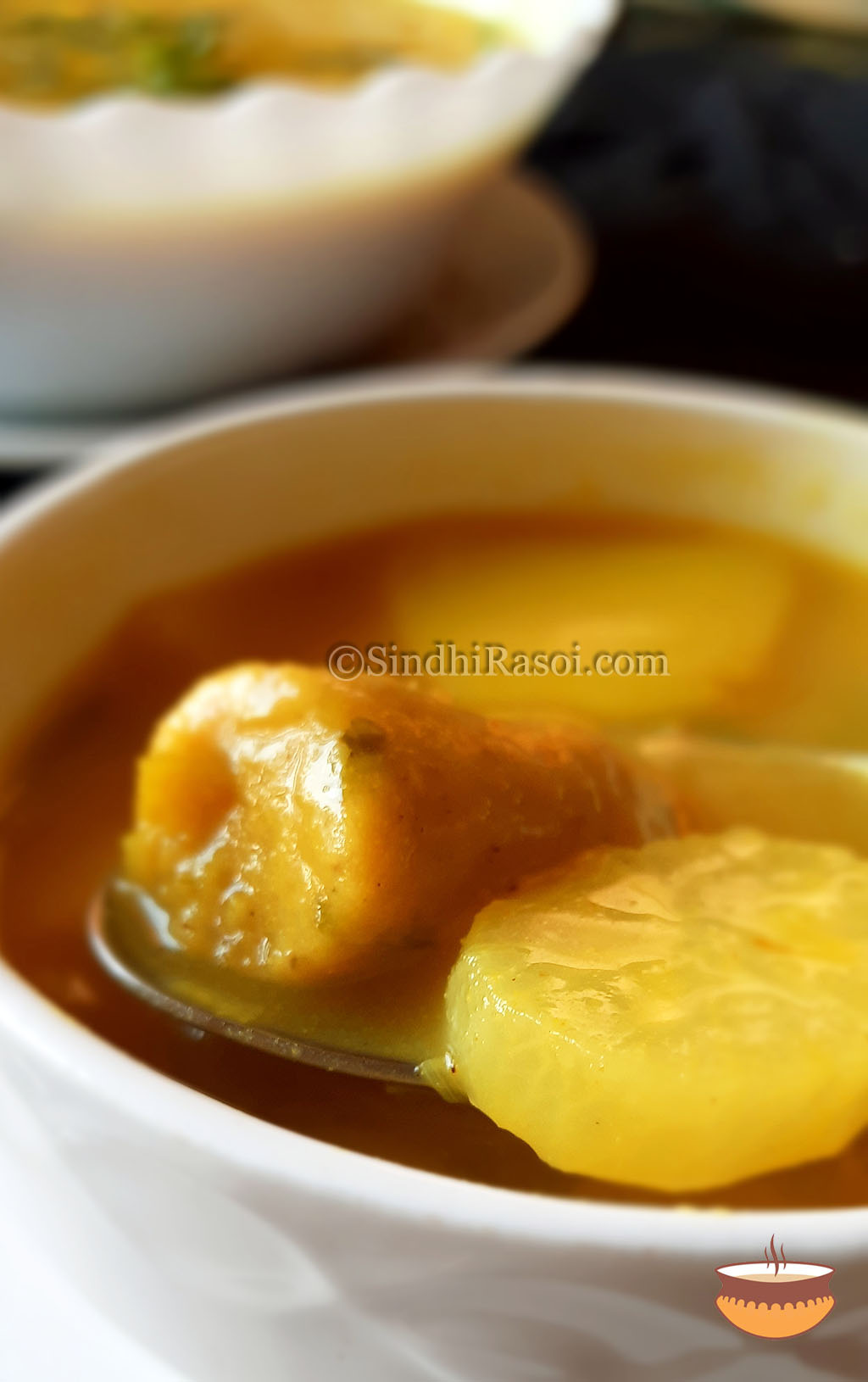
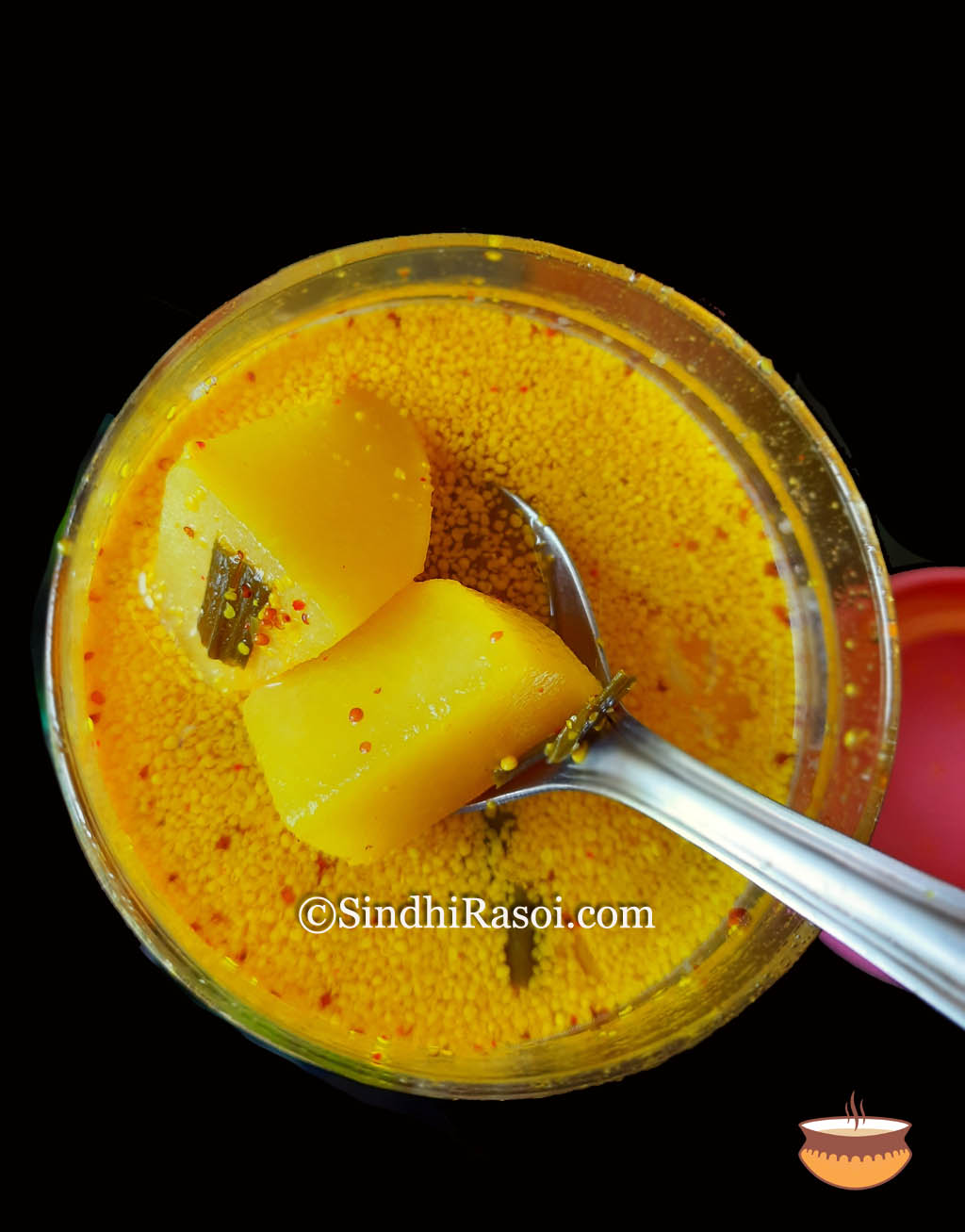
One such dish in Thoom Jo Ras, also known as Aur Jo ras or Thumaro, where Thoom/Thum stands for garlic, Aur means Mustard seeds and ras means juice or extract!

This garlicky soupy kadhi is made in various ways across the community and the variations are way too many! I am yet to confirm if Thumaro and Aur jo Ras (have already share its recipe on the blog) are variations of one dish or whether these two are different dishes cooked across the different sub castes!
So while Aunt K would not add any flour to the Kadhi, Thumaro at many homes is cooked with a base of some flour added to the kadhi. It could be Jowar or Besan, could be sautéed in the beginning or could be added as a paste in the simmering kadhi. The idea is to thicken the kadhi, to add some more nutrition and boost the flavors.
The choice of vegetables added to Thumaro varies from home to home but then certain ingredients like garlic, mustard seeds, potatoes, radish etc are mandatory.
Raw dough balls flavored with garlic, chili powder and salt are most savored in this kadhi and while Aunt K would use Besan to make dough dalls, one can use Jowar flour too.
The souring agents could be tamarind pulp, amchoor, dried raw mango slices or even tomatoes or combination of any two of the above mentioned!

Rating
- Garlic -1 whole pod
- Fresh green garlic (4-5 stalks with bulbs)
- Green chillies 2-3
- Mustard seeds 2 tsp
- Tamarind pulp 2-3 tsp (more or less as per your taste)
- Sliced or cubed vegetables like Radish and Potato (I used 2 potatoes and one small Radish)
- Jowar flour 1tbsp
- Gram flour- 1 cup
- Red chilly powder ½ tsp
- Oil 2 tsp
- Water, a litre or more
- Coriander leaves for garnishing
- Pound peeled garlic cloves and fresh garlic. Save 2-3 tsp for besan dumplings/rolls and use the rest of pounded garlic (including fresh garlic) in kadhi.
- In a bowl take 1 tbsp of Jowar flour and gradually add some water, mixing it well to assure no lumps are formed.
- In a pan or a sipri, heat around 2 tsp of oil and add mustard seeds and allow to crackle. Add pounded garlic and saute till aromatic. Do not let the garlic burn.
- Add sliced radish and potato chunks and add the jowar flour paste, turmeric, chopped chillies and about a litre of water
- Add tamarind pulp, salt and let it boil for few minutes on high flame.
- Lower the flame and let the kadhi simmer.
- Meanwhile add some salt, some crushed garlic that you have set aside for besan dumplings and some red chilly powder to the gram flour and knead a stiff dough using little water. You can use jowar flour instead but I prefer besan here.
- Make small oblong rolls of this dough (yields 6-7 rolls) and drop them in the simmering kadhi.
- Cook until potato and besan rolls are cooked from the center (anywhere between 20-30 minutes
- Add water if required! This kadhi is of dilute consistency. Adjust the seasoning.
- Garnish with some chopped coriander leaves and enjoy it as a soup to warm yourself or pour it over some Khichdi or rice and have a hearty meal
To understand and learn the formation of Sindhi alphabets, kindly refer the video shared!
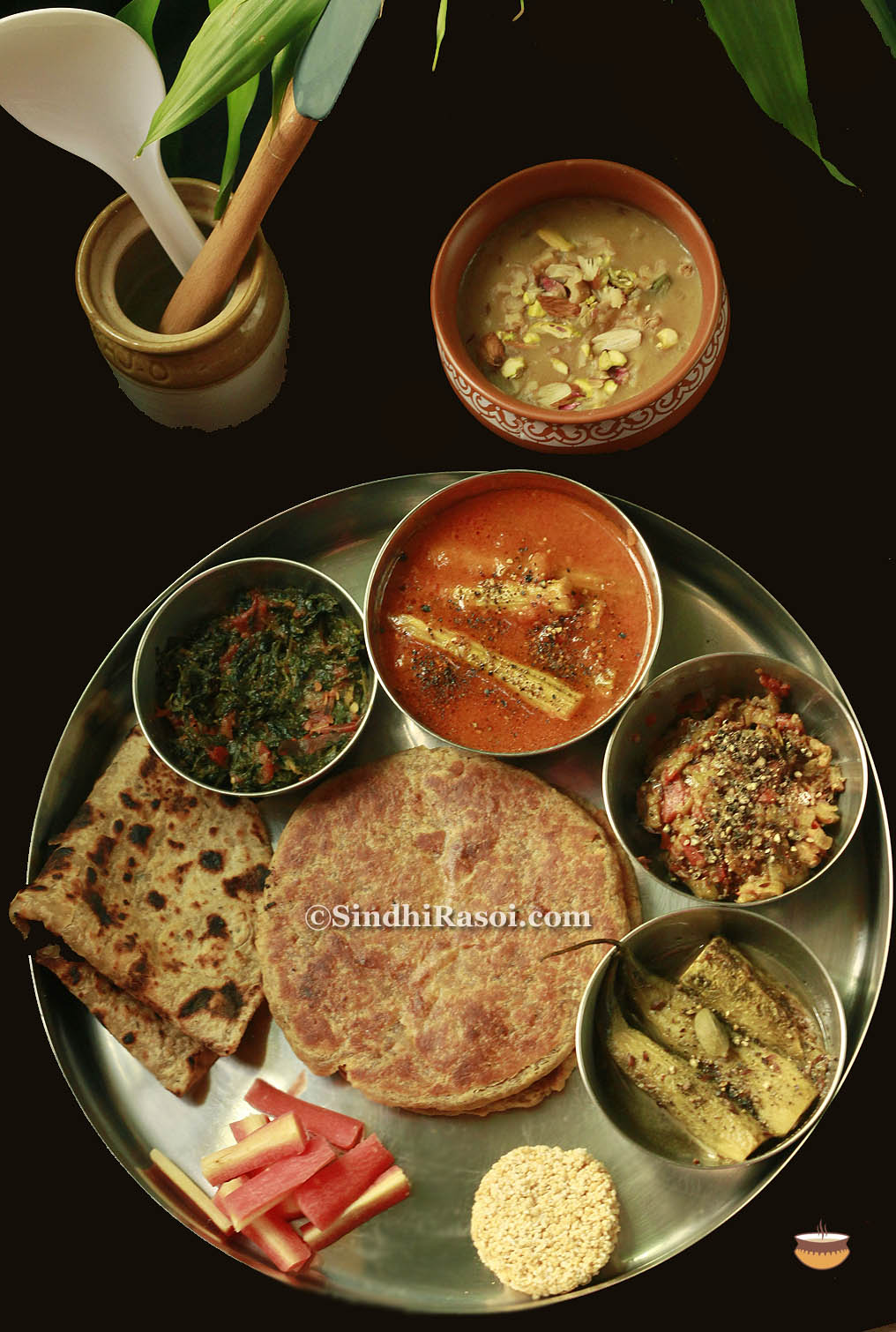
While I was making Thumaro I was reminded of another favorite of mine that Aunt K would cook whenever green garlic was in season. Honestly speaking I couldn’t remember the name of the dish but suddenly when someone mentioned and described the dish, all the memories came gushing in and I couldn’t help but recreate the dish!
Do let me know if you are hungry for another Chhapru style dish made using green garlic as a star ingredient, and I will share the recipe. Else I will move to the next alphabet!
Do comment and share your views/suggestions/recipes and food pics! I shall wait for your inputs!

Alka, kudos! I truly look upon you for all the knowledge you impart. I had heard the surname Chapru, but had no idea about them, or their food.
This is a unique recipe, and while the fresh green garlic is available I will definitely try it. The besan rolls sound like gatta – may be small ones! Correct me if I am wrong.
Should I serve it with Sindhi Khichri or rice?
And yes please please do share all your green garlic recipes, it is one of our favourite ingredients.
Hello Vaishali,
Thank you for your kind words!
Yes, the besan rolls taste like the Gatte of Gatte Ki kadhi and yes, these are smaller in size (like Muthiya). Aunt K, the CHapru neighbour would serve it with Khichdi but at our home we used to have this as it is, like a chunky veg soup.
Alkaji,wish you have a way to print “Recipe” from these articles.
Love your AlifBe series. The way you bring out Sindhi heritage through storytelling, peppered with unique and lost recipes, is just awesome. Do post the other Chhapru green garlic recipe.
Thank you so much for your kind words! I have shared another Chhapru style dish, Thoom jo Vado! Please do check and let me know your views about that 🙂