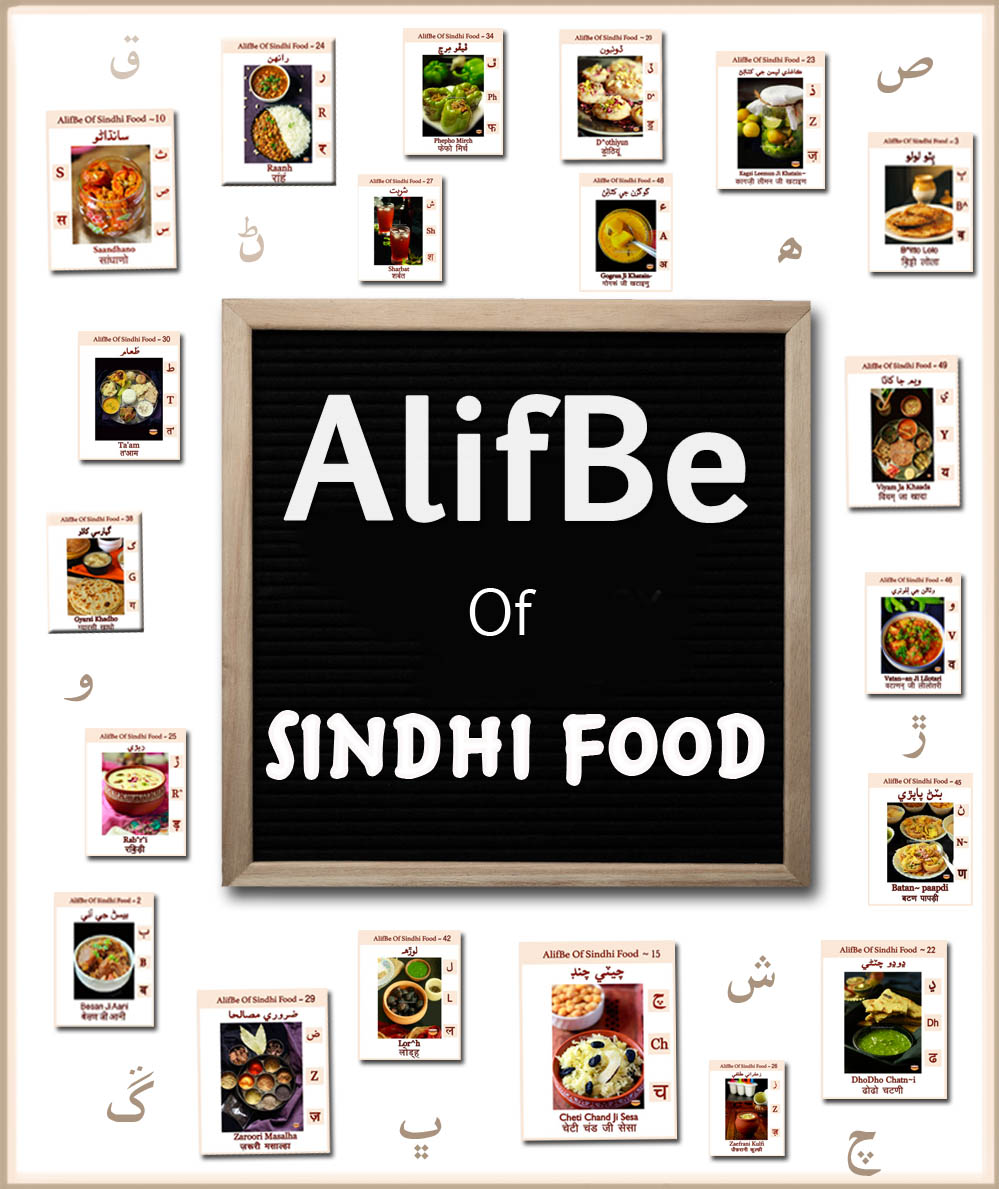
The next letter in AlifBe for Sindhi food series is ڀ i.e Bh or भ as in Bharat or Bhutan.
Please Note: If you don’t wish to read further but want to directly move to the recipe of Bheendi Pickle, then kindly click here!
Else, do read on……
If you remember previous posts then you nay have noticed that except first alphabet ا (A), rest three alphabets covered so far ; ب (B), ٻ (B^), پ (P) have same basic shape while the number of dots vary! The fifth alphabet is formed using the same basic shape having 4 dots below the horizontal line.
And a Sindhi dish starting with the alphabet ڀ i.e Bh or भ is Bheendi!
No it is not an Okra dish! It is a classic Sindhi Pickle made from raw mangoes!

The Sindhi Community is famous for its Pickles and Papad and Shikarpuri pickles were and still are the most famous pickles. Shikarpur, a city and capital of Shikarpur district in Sindh, was a well known hub for gold and spice trade along with cotton, brass etc. It was the city known for its schools and was the first city to have and intermediate college.
Shikarpur was also popular for its distinct pickles and the credit would always go to the underground water of Shikarpur which used to be so sweet that the vegetables grown there would have peculiar flavors that would reflect in the flavors of Shikarpuri Pickles and hence pickles from Shikarpur would be toothsome and many a times even, exquisite, like the Bheendi pickle!
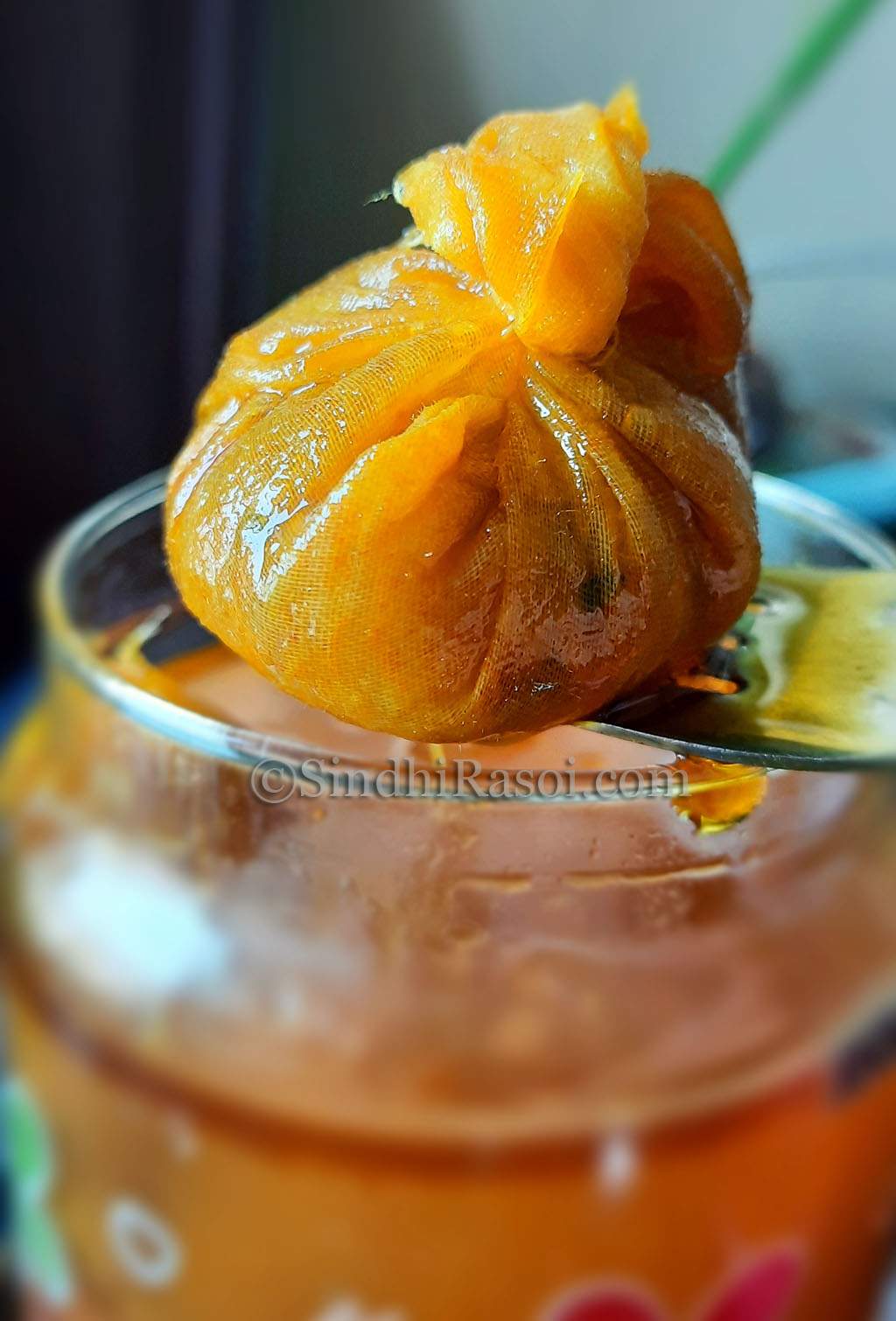
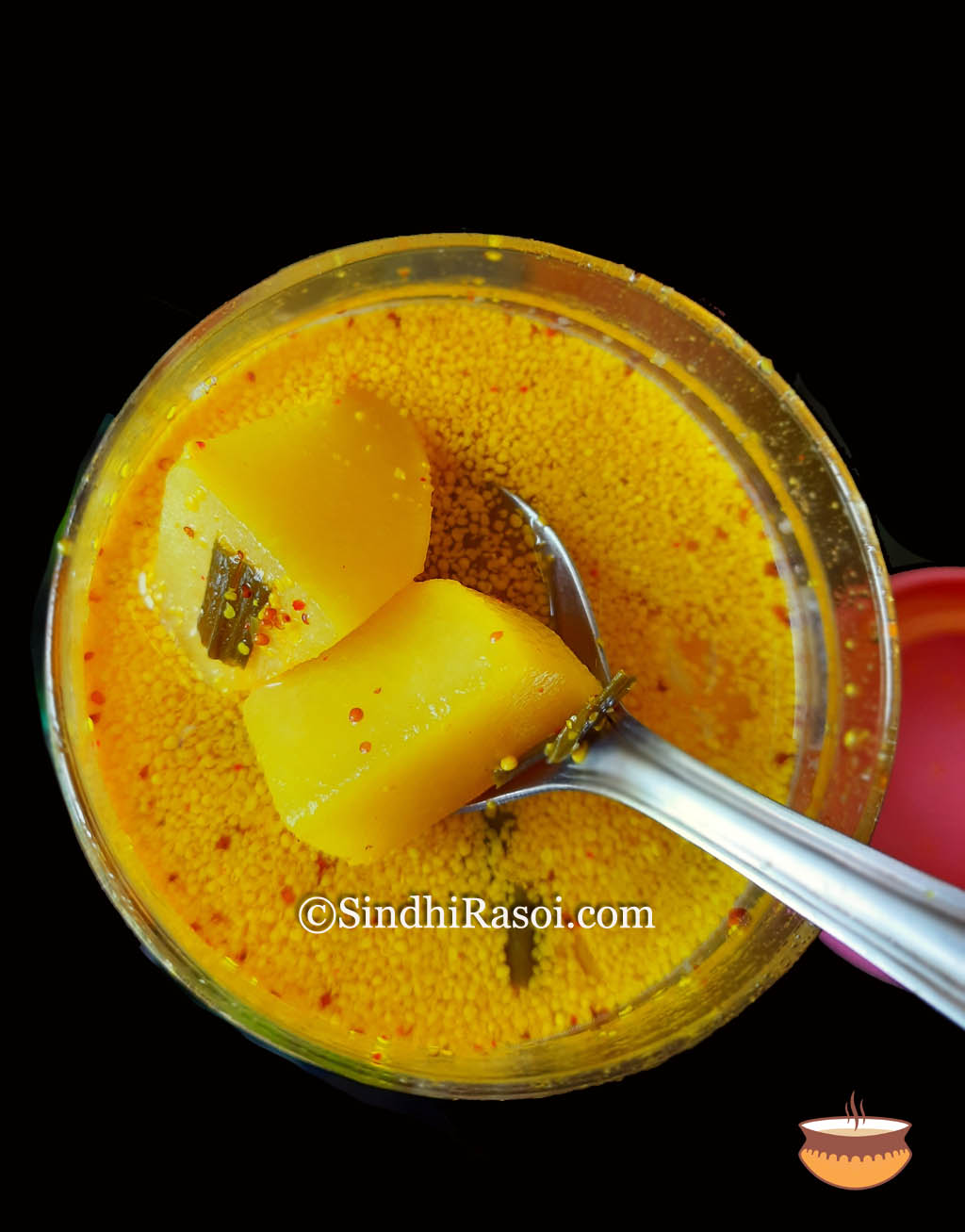
Bheendi pickle is made from grated raw mangoes mixed with popular pickling spices like fenugreek seeds, kalonji, fennel seeds etc. but what makes this pickle unique is the way it is pickled. Spoonful of the pickle mix is tied in a potli of muslin cloth and the process is repeated for rest of the mix.All the potlis are then left to mature in the water+vinegar+mustard oil bath!

I know many of you might be wondering about the name Bheendi and trust me, you are not alone!
They say “It takes a village to raise a child” and this project ‘AlifBe of Sindhi food’ also takes a village to exist, thrive and prosper!
Only those who got involved with me in my hunt of the traditional dishes, the proper pronunciations and the ‘nomenclature’ of the dishes, would know how exhausting this research and the project could get!
I was always intrigued by the word Bheendi used for this pickle considering Bheendi was the term used for Okra but all I could gather was that it is called so because the pickle looks like a dot or bindhi. I was not convinced at all but since Spoken Sindhi is not as standardised as written Sindhi I assumed that maybe Bheendi is a corrupted word for Bindhi and my life moved on peacefully until the moment I reached for the alphabet BH in this AlifBe for Sindhi food series!
As usual I first turned towards my better half to help me find some references in Sindhi Dictionary. Nothing helpful was found in the one we had. Then began the unending discussions with Barkha Khushalani Di (the one who is generously helping me out in this project since the day it was conceptualised) and for several days the brain storming went on and on but we were unable to conclude something assuring.
I was getting restless but got some hope from the Kutchi connection; the Bandhani process (Tie and dye process) where tiny portions of fabric are tied using nylon threads (called Bheendi in local language) in specific patterns and dyed to make the popular Bandhani style clothes. Bandhani tie and dye process is known from Indus Valley civilisation era (As early as 4000 BC) and this dyeing process was introduced and popularised by Khatri community.
I had a hunch that the way this pickle is tied in muslin cloth the name Bheendi might have a connection with bheendi in Bandhani. But I am yet to find if that is the real reason for the pickle being named Bheendi. I tried contacting with some people from Cloth (retail)/ dyeing/ weaving industries but am yet to get some relevant information about the connection between Bandhani Bheendi and Bheendi pickle.
And just when I was about to give up, I received this message from Surrayya Kapri “Bheendi refers to tying your head with a cloth. Bheendi is tied using a cloth around your head to secure the rao (dupatta). In Sindh, older ladies tie a bheendi round their heads.”
Phew!!! I finally got some relevant answers!
BTW Surrayya Kapri from New Jersey, is a fan of Sindhi language, culture and food (cooking included). Her ancestral town is Kunri in Umarkot, Sindh, which is a big market for red chilies. She often shares with me the lesser known recipes/dishes/ jewellery/attire/fabrics/traditions of Sindh and Sindhis from bygone as well as modern era and we both often crib about the way our culture is losing its sheen.

So now that we know why Bheendi pickle is named so, let us focus on how this pickle is made!

Some make this pickle using tender raw mangoes (Kairi) while others use Rajapuri raw mangoes (not the kairi but the raw mangoes)
You can find the recipe of the Bheendi khatti using raw mangoes, here!
This pickle is also known as Kadhukash/Kadhukas/Kadukas/potli/gathri/gathiri pickle and the recipe varies across the community. Some do add whole spices like Kamaal Patt (Tej Patta), nutmeg, cinnamon etc along with the regular pickling spices while others avoid whole garam masala.
And now comes a little twist!
It ain’t a mango pickling season yet, in Mumbai but a fortnight ago I found some tender raw mangoes in the local market. We generally don’t get tender mangoes in January/Feb in markets around. Felt skeptical enough to not buy in bulk but couldn’t resist the temptation of buying a few since I had a recipe to try out.
For those who are connected with me via Instagram might remember a post shared by me, about some traditional Bengali ingredients that I purchased from Amar Khammar, an online portal and one of the ingredients was Panchphoron, a typical spice mix used generously in Bengali cuisine.
The Panchphoron is a mix of five spices; Fennel seeds, Mustard seeds, Cumin seeds, Kalonji (nigella seeds) and fenugreek seeds.
I was curious to try a variant of Bheendi pickle using Panchphoron mix, since fennel, fenugreek and Nigella seeds are used in Bheendi pickle.
I wanted to check how the pickle flavors vary if cumin and mustard seeds are added along with other spices and how different the pickle would taste considering that the proportion of each of the spices used in Sindhi style may be different from the proportion of each spice used in Panchphoron mix.
So I pickled two mangoes using the panchphoron mix and I must say it works fairly good!
So what I did was that I grated 2 mangoes (tender raw mangoes, but sadly the texture of mangoes after grating was not good enough)
and to it I added salt, 3 tsp of Panchphoron mix, some turmeric, around 10 garlic cloves, 1 tsp red chilli powder, 2 tsp of crushed patali gur (Date palm Jaggery, courtesy Mr Arun Kumar Pandey), a dash of asafoetida and mixed 5 tbsp of mustard oil that was heated to smoking point and cooled before using. Rest of the process was same as that of Sindhi Style Bheendi pickle.
So can you think of other Sindhi dishes starting with ‘Bh’?
Do share pictures/recipes of Sindhi dishes cooked by you and I will publish selected few on this blog, with due credits!


Marvellous