Towards the end of the year 2007, I was toying with an idea to start an online journal to share my mom’s recipes since there was absolutely no presence of Sindhi cuisine across the World Wide Web and slowly but gradually with the help of my techie hubby I was able to start the blog ‘SindhiRasoi.com’ and managed to publish the first post on 29 th January 2008. The rest, as they say, is the history! This baby is now a teenager!
Looking back, I am amused how one thing led to another and my life changed with every baby step I took; from hesitating to even switch on the computer to managing a blog, from being painfully shy of interacting with strangers to standing on a stage of Kalina University talking about Sindhi food, from being clueless about how to click a picture to taking up small projects of food photography, from being ignorant about our own culture to expanding my horizons and enriching my life by learning about other regional cuisines, I have come a long way and today as we are celebrating 13th anniversary of this blog I can’t help but thank all the lovely readers of this blog, my family who stood by me through thick and thin, express my gratitude to friends who kept me motivated with kind words, encouraging feedback and unwavering support!
There are many ways to celebrate happy occasions and not all involve cutting a cake or throwing a big bash. To mark the occasion I am taking up a sweet interesting project. Allow me to deviate from Sindhi food to Sindhi script but I promise I will end up connecting both!
Believing that their roots are in Indus Civilization, Sindhis do take pride in their culture and heritage but sadly that fails to reflect in their day to today life. Being a Diasporic community without having a State (in context of a Civil Government/territory), it is hard to let our language, our rituals, our culture thrive or prosper. Our ancestors lost their lands, riches, pride, neighbours, jobs etc. but their desperate attempts to fit in the new surroundings resulted in loss of our cultural ethnicity. With almost zero air time available for Sindhi content on National TV/Doordarshan, connecting with our community via art/tele series/ sitcoms/ News etc. is not possible. Since Sindhi community is dispersed far and wide, Radio (FM/AM) or Movie theatres can’t be of much help, to collocate the community, virtually or otherwise. Internet/websites/YouTube/Social media are some of the channels that are helping the community to come closer but a lot more is needed to connect us with our roots.
Though spoken Sindhi is somehow thriving, it is the Sindhi script on its deathbed that desperately needs to be resuscitated and no matter how divided the literary flag bearers are, over the use of varying scripts, the fact that most of our accessible traditional literature is available in Arabic script, makes it crucial for us to be well versed with the script if we really need to learn about our roots, our traditions, our culture and rich heritage.
Originally Khudabadi (Khudawadi)/ Hatwanki, Khojki scripts were used by Sindhis, the base of many scripts being Lahnda, an unstandardised script used by the business community.
Under British rule, for their convenience, a Persian- Arabic script adopted by government officials, was made mandatory for all, somewhere in 1852.
There are very few Sindhis who can read Hatwanki/Khudabadi and I am not sure how much of literature written in other Sindhi scripts is accessible to Sindhis in India. Though there are still good number of elderly Sindhis in India or abroad, who can read and write Arabic Sindhi, very few from my generation and almost none from the Gen Z can boast of being well versed with Sindhi Script. We can’t even identify the basic consonants/alphabets of our script.
My spoken Sindhi is good enough but I cannot read or write in Arabic Sindhi and it pains me when I am unable to decipher old articles/books/documents or literature written in Arabic script. So now I am trying to learn the script. And it is very challenging to say the least, since there are 52 consonants in Sindhi and 10 vowels!!!!
To make sure that I pursue this well, I am trying to associate it with Sindhi food, so that my passion will fuel the fire and I will be consistent enough to get through the basics of the script in few weeks. And how am I planning to achieve that?? Here’s how…
My friend, philosopher and guide Dr Kurush Dalal is currently doing these highly informative and interesting Insta Live sessions (you can follow him here) everyday, called ‘The A-Z of ingredients’ (Know your ingredients) going in an alphabetical order, he picks an ingredient and a whole session is dedicated to that particular ingredient, its origin, uses, interesting trivia/fun facts and nostalgic memories associated with dishes cooked using it. He started with A for Aloo and today he was on T for Turmeric. I find it a very interesting, systemic way of discussing food or ingredients.
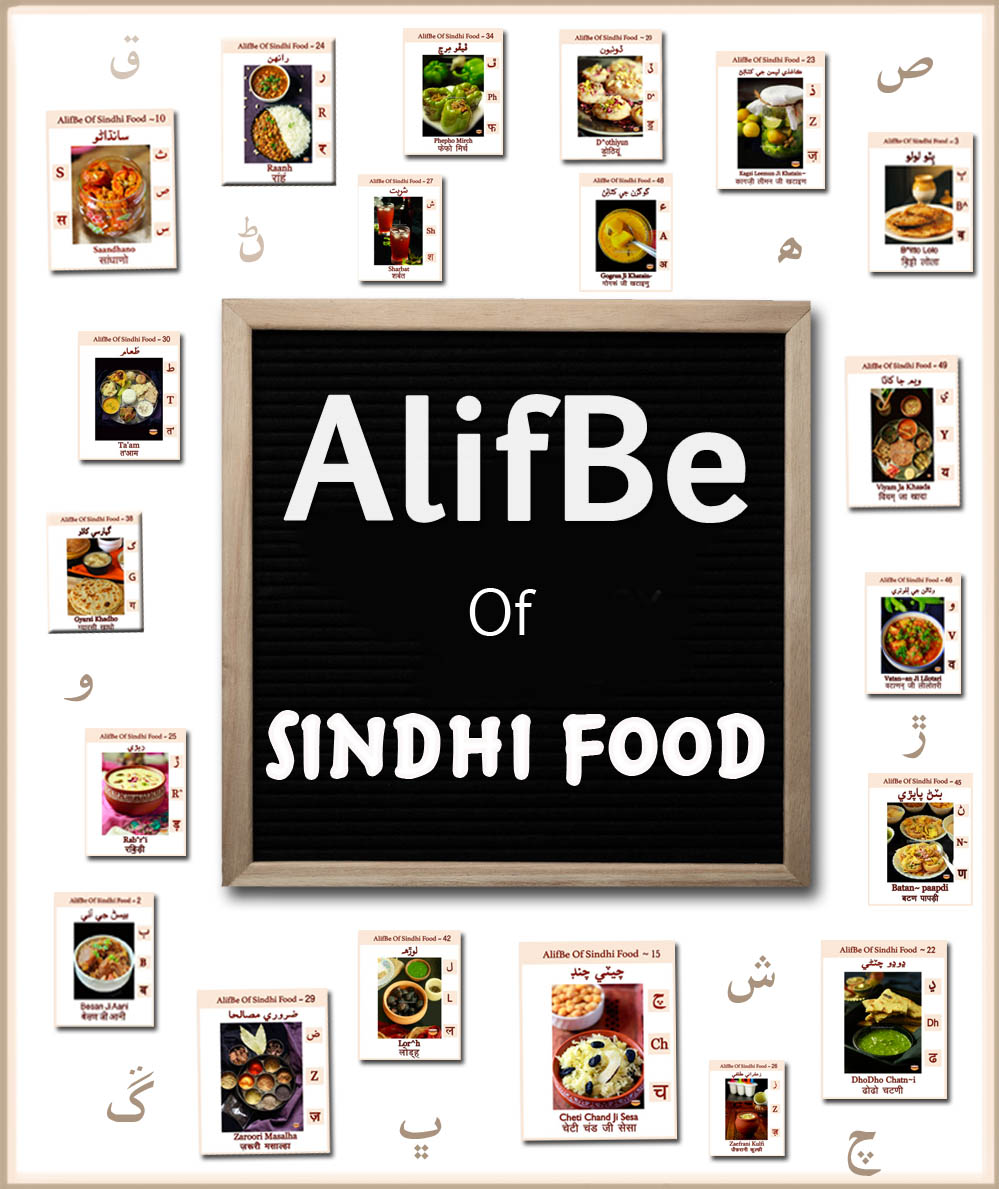
Taking inspiration from him, I am planning to do something similar yet different. The SindhiRasoi’s A- Z series will cover the Sindhi alphabets instead of English A-Z.
Starting from tomorrow, I am going to share the letter ( a consonant) of the day and discuss a Sindhi dish, the name of which starts with that particular letter. The alphabet will be in Arabic Sindhi, the dish will be from Sindhi cuisine (Veg dishes on this blog, though I may share details of Sindhi Nonveg. dishes in my Insta Stories) and the name of the dish too will be Sindhi. So Aloo paratha wont be considered under ‘A’ but under ‘P’ as it is called Patate waaro Phulko in Sindhi. Got the drift?
More details coming up in the next post. I will be sharing much more information on my social media handles. So you can connect with me via Facebook, Twitter, Instagram, LinkedIn or this blog!
I would be heavily relying on my better half, my son (who can read and write Sindhi) and on the app named Learn Sindhi, an amazingly helpful app by Asha Chand ji, a living legend, one of the best-known champions of Sindhi language! And I can’t proceed without thanking Barkha Khushalani Di, a poetess, columnist, translator and promoter of Sindhi music and culture, will be holding my hands as I sail through the alphabets, guiding me about the proper pronunciation, about apt names of the dishes and about how to write the alphabets and words in Devnagri and Roman Sindhi to make the process easy for you to follow if you are a stranger to the Sindhi script, like me!
See you tomorrow (keeping fingers crossed) with the first letter of the Sindhi Alphabet and a corresponding Sindhi dish!
I need all the motivation, best wishes, gentle push and constant backing from you all to get through this challenge! I hope we all will be together in this!
Jai Jhulelal (Greetings in Sindhi)!


Jai Jhulelal !
ALL THE BEST. Let us learn every second of our life something new.
Jai Jhulela!
Yes one must never stop learning!
Jai Jhulelal Alka. That’s a wonderful idea. So glad to know you are learning Sindhi (Arabic Script). I also learnt it myself during my schooling days. Got some books from Ulhasnagar. Those days thatwas the only option for us.
Looking forward to your posts . I am sure you will make them really interesting and informative as always.
Thank you so much for your kind words and yes, learning Arabic Sindhi was long due. My father tried to teach us and while my youngest sister picked it really fast I could only remember the phonics/ alphabet song but memorising the letters felt a daunting task. Years later hubby tried to teach but once again our son picked up the script very fast while i lagged way behind. I am slow in that way but then if i start learning on my own, I find it easier to learn. Keeping fingers crossed this time! But well will need all the help and guidance and I am counting on you too!